


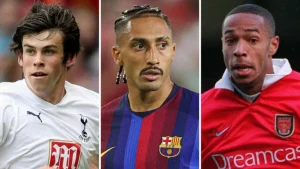


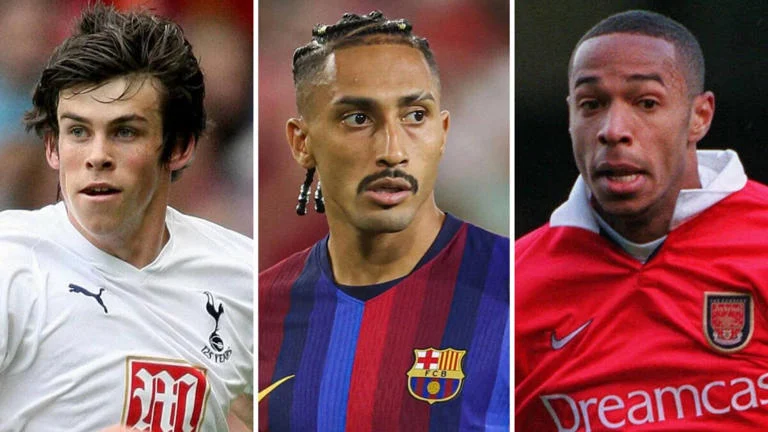


Raphinha starred as a right winger during his time in the Premier League but has shown incredible versatility since moving to Barcelona. The Brazil international was unfortunate to miss out on the Ballon d’Or after a superb 2024-25 campaign on the left wing, and has now started this campaign as the central striker in Hansi Flick’s side.
Here are 15 other players who thrived after changing positions according to Planet Football on Wednesday.
Thierry Henry
When Arsenal signed Henry from Juventus in 1999, he was a winger who had struggled to make an impact in Serie A. But Arsène Wenger had other ideas. “At a certain point, I wanted to go to Wenger and tell him to put me back out wide,” Henry once said, reflecting on a period when he failed to score in his first seven Premier League appearances. “Then, I said to myself that I had to react, that I couldn’t fail a second time, only a few months after a negative experience in Turin.” Henry went on to score 228 goals in 376 games for the Gunners.
Gareth Bale
It is often forgotten that when Bale produced the performance that introduced him to the world — a hat-trick in the San Siro in Tottenham’s 4-3 defeat in 2010 — the unstoppable Welshman flying down the wing was wearing the No. 3 shirt, having largely been considered a left-back until that moment. “The most amazing thing ever was that when we played them at home, they left Maicon at right-back, one against one, against Gareth,” recalled Harry Redknapp. “He destroyed him again. It was the end of Maicon.”
Cristiano Ronaldo
Due to the presence of Raúl, Ronaldo was unable to take his favoured No. 7 shirt when he joined Real Madrid and instead spent his debut campaign wearing the No. 9. After first coming to prominence on the wing, Sir Alex Ferguson eventually pushed Wayne Rooney and Carlos Tevez out wide to accommodate Ronaldo as a central striker. Considering the number of goals Ronaldo has gone on to score, Rooney and Tevez shouldn’t feel too put out.
Ousmane Dembélé
Dembélé arrived at Barcelona with a reputation as one of the most exciting young wingers in the world, but his six-year spell at the club was plagued by injury problems and inconsistencies. His most memorable moment at Camp Nou is arguably missing a chance to give Barça a 4-0 first-leg lead over Liverpool in the 2019 Champions League semi-final. Nobody then would have predicted that the France international would become the main striker at Paris Saint-Germain a few years later. He has thrived in that role under Luis Enrique, winning back-to-back Champions League titles and a Ballon d’Or.
Ryan Giggs
Giggs was the archetypal winger for the majority of his Manchester United career: direct, quick and skilful. In his later years, however, he displayed the footballing intelligence to become a calming influence in the centre of United’s midfield, picking the passes for more explosive attackers such as Rooney and Ronaldo.
Bastian Schweinsteiger
With Sami Khedira injured, Christoph Kramer concussed and Toni Kroos struggling, Schweinsteiger produced the definitive performance of his career in the 2014 World Cup final. From central midfield he almost single-handedly battled the whole Argentina team, leaving the Maracanã with a black eye, a bloodied face and a winner’s medal. It was a far cry from the first eight years of his senior career, which he spent playing out wide.
Andrea Pirlo
Pirlo started out as a No. 10 at Brescia, Inter and Reggina. Carlo Ancelotti eventually deployed him in a deeper role at AC Milan. “He changed my career, putting me in front of the defence,” Pirlo said. “We shared some unforgettable moments.”
Joelinton
Joelinton joined Newcastle United in a then-club-record £40 million deal in 2019 and was handed the No. 9 shirt. He scored just six Premier League goals across his first two seasons and appeared destined for the exit. Everything changed under Eddie Howe, who moved the Brazilian into midfield. He has since become a fan favourite and was part of the side that ended a 56-year trophy drought by winning the 2025 Carabao Cup.
Philipp Lahm
Lahm was already world-class at both full-back positions. The arrival of Pep Guardiola at Bayern Munich saw him move into midfield, where he produced typically outstanding performances. “Philipp Lahm is perhaps the most intelligent player I have ever trained in my career,” Guardiola said. “He is at another level.”
Fabinho
Fabinho started his career as a full-back before a phone call with then-Monaco manager Leonardo Jardim turned him into a defensive midfielder ahead of the 2016-17 season. “Looking back, that was a life-changing moment,” Fabinho said. He later moved to Liverpool and established himself as one of the best defensive midfielders in the world.
Ben White
White joined Arsenal from Brighton in a £50 million deal in 2021 and formed an impressive centre-back partnership with Gabriel Magalhães. The emergence of William Saliba threatened his place, but a move to right-back allowed Mikel Arteta to play all three in the same defence. White is now considered one of the best in his position in the Premier League and helped the Gunners win the title in 2025-26.
Javier Mascherano
Unable to break into a Barcelona midfield of Sergio Busquets, Xavi and Andrés Iniesta, Mascherano reinvented himself as a centre-back. “I had zero experience in that role but it happened naturally,” he said. “It’s very clear to me that had that change of position not occurred, I would have been out of Barcelona many years ago.” He made 334 appearances for the club.
Antonio Valencia
As a winger, Valencia initially shone at Manchester United after joining from Wigan, but his form dipped under the pressure of the famous No. 7 shirt. A positional change proved key, and by January 2017 José Mourinho had labelled him “the best right-back in the world”.
Gianluca Zambrotta
Zambrotta joined Juventus from Bari in 1999 as one of Italy’s most exciting wingers. An injury at the 2002 World Cup saw Mauro Camoranesi impress in his place, forcing Marcello Lippi to convert Zambrotta into a full-back. Capable of operating on either side of the defence, he went on to win honours with Juventus, Barcelona and Milan, plus the 2006 World Cup.
Lothar Matthäus
In 1990 Matthäus was named German Footballer of the Year after captaining his country to World Cup glory, scoring four goals from midfield. In his first 12 seasons he scored 168 goals as a midfielder. In 1998, at the age of 38, he was again named German Footballer of the Year, this time shining as a defender or sweeper at Bayern Munich.


