

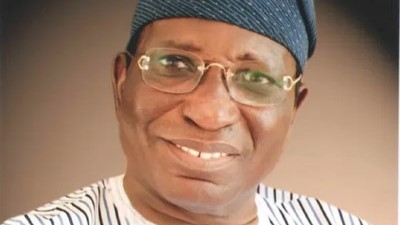
Former Plateau State Governor under the Social Democratic Party (SDP), Ambassador Fidelis Tapgun, in this interview with LEO SOBECHI, says that politicians should allow President Bola Tinubu eight years to conclude actions on insecurity and restructuring of the country.
How does Nigeria make you feel at this point in the nation’s history?
God has been kind to us in this country because of the way He has handled us, allowing us to survive despite all the insecurity. Mainly, the insecurity across the land, because that is the worst enemy of humankind. The insecurity that does not allow you to go out in the morning, you cannot sleep with your eyes closed, you cannot travel, you cannot go to your business or to the farm, is the greatest enemy of mankind. But, so far, God has allowed us to survive in this condition. And the government, the President, has been working extra hard to eliminate this insecurity.
I know it’s going to be very difficult, because I think it is just that recently people are getting to understand that what we were seeing was just on the surface. But with recent happenings, we discovered that the thing is deep-rooted and that the whole government institutions have been infiltrated. The stories we hear are so discouraging, but God, in His infinite goodness, has been leading the President and is dismantling it bit by bit.
That’s why when Abacha said, if insecurity continues beyond two days, the government has a hand in it. It would appear that the government has been part of this problem all along. But, like I said, the government, I think Tinubu’s appearance on the scene now is a blessing to Nigerians. It’s a blessing to us because he appears to be handling it with caution and firmness. Nigeria is a very complex society, both in terms of religion, tribes, and in terms of social backgrounds. These are complicated factors, so he’s been handling it effectively with caution. And I think we shall get out of it by the grace of God.
But a lot of people are also worried that, while the Boko Haram insurgency was only restricted to the Northeast, the sudden proliferation towards even the Northwest and Northcentral appears to be curious.
That’s what I’ve just said, people were thinking it was confined to the Northeast, where Boko Haram started.
Gradually, the Northwest started, but from the look of things now, and from what the Americans are saying, these people are in all parts of the country. Their cells are in all parts of the country; satellite pictures show where they are.
That’s why I said from the beginning that we didn’t know the depth of the problem. Even the President, I’m sure, didn’t know. It is only from somewhere this thing triggered, revealing itself now. And the Americans are talking because they have details about everything that has been happening all this while.
From the Boko Haram thing during Kashim Shettima’s governorship in Borno, they have all the details, and I’m sure they have been sharing it with the government all through. But, in our usual way, nothing concrete was done, just whitewashing it, but it has gotten to a stage. And, like I said, it is God’s intervention that has revealed the depth of this thing now to us, because God wants to solve it for us, using the President.
Are you saying that President Trump’s declaration of Nigeria as a country of particular concern is a blessing in disguise?
It is a big blessing in disguise. Otherwise, we wouldn’t have known the depth of this insecurity. Most Nigerians wouldn’t have known. And like I said, I’m not too sure even the President himself knew the depths of the problem on the ground when he took over.
But, over the years, since 1999, when we took over, this constitution that was drawn for us by the military was drawn in favour of one particular religion, which is what has been trending all through, yet we go out and say we’re a secular state. You see my point?
Whereas, in reality, we are not, because the constitution gives leverage to a particular religion in the country and it has been used effectively, quietly, especially when we were taken into the OIC by military President Ibrahim Babangida. That was the climax of the whole thing. We became a member.
We are facing a complicated situation, because we are a people of diverse cultural backgrounds, some 200 million people. It’s not a joke. Well, the President has been handling it carefully and maturely, but I think he is handling it effectively.
He has been handling it with care, so that no part is injured, no part is offended, and we want to move in peace together. So, we thank God for their revelation, and we thank God that it came at a time when this President was in power. Of course, he’s not a fanatical Muslim; he has his wife a Christian, some of their children are Christians, some are Muslims.
In a few days’ time, Nigeria will enter 2026, a pre-election year. What do you expect from Nigerians and politicians?
Well, the electioneering has started already. The President has identified his zonal coordinators. Everybody has started. But what I just advise politicians, and this is something we should learn to keep in our hearts, is that not everybody will be a leader at the same time.
And there are leaders appointed by God at certain times in their lives to lead people. So, when such people come, give them the opportunity to do what God has asked them to do.
So, for me, I think all this energy being expended on all these things, politicians should rally around the President, let him sort out the matter of security and the economy of the country to improve. I’m more particular about this security thing.
But the constitution has said four years, are you suggesting that eight years should be automatic? Are you hinting at the so-called danger of a one-term presidency?
What would a one-term president achieve? You have not done anything. What the President is laying out now, he cannot finish them in four years. He needs time to complete them and establish them concretely on the ground.
Like the constitutional amendment I’m talking about, if he does it next year, in 2026, he will need to consolidate; the thing will have to be consolidated in his second term under his oversight until it is properly on the ground.
All the major loopholes, all the major hiccups that would have been coming up, he would have been able to sort them out himself, so that it is firmly on the ground by the time he leaves in 2031. Anybody who is taken from that term will just be building, nothing new again.
What he does in this constitutional amendment, if he does it now and leaves, anybody can come and scatter it, and it will not be good for the country.
Do you see any merit in the suggestion for a single term of five or six years? Is there a need for another constitutional conference?
We didn’t agree on a single term in the first place, from the beginning. Even at the national conference, I think we didn’t agree on that. We didn’t agree on that. I can’t remember very well, but I think we did not even agree on that.
What we even said, I think, was to say, okay, if you want it for one term, let it be eight years for one term, not five years. We said no. I think we didn’t agree on that five-year one-term, still at that time.
I do not see the need for another constitutional conference. If the President does this thing we are anticipating he’s going to do, this constitutional amendment that he’s going to do, once he does it, he has finished the problem of Nigeria; he can go and sleep.
Now, there is this allegation that the APC is dragging the country to a one-party state. Is a one-party state feasible?
I don’t believe in a one-party state. But even the way it is going, it is because we don’t have a philosophy in the parties. There is nothing concrete holding anybody in the party except as a platform used to get elected. That is why they move from one party to the other.
I know Tinubu is a progressive; he’s a Social Democratic Party man, so he will not allow it, and I don’t think one party is in his thinking at all. He can’t drive away people coming into APC. That’s democracy. People are allowed to move. People are allowed to decide on where they belong.
But from the statistics, PDP is still there. The Labour Party is still there, controlling some places, and it will remain like that. After 2027, you will see the emergence again of other strong political parties, especially the PDP, coming back to power in some states.
Is review of the 1999 Constitution better than a brand-new constitution, as some patriots were asking for?
What we did at the 2014 Constitutional Conference was to produce a people’s constitution. In fact, what led to that Constitutional Conference was the demand for a new constitution. The general agitation all over the country for a new constitution was because the 1999 Constitution was not made by Nigerians, but by the military. Former President Goodluck Jonathan convened that conference for a new constitution to be produced for the country.
In his opening speech that day, he had told us that this was the essence of that meeting. He said that everything we discussed and agreed upon, there are some he will sign into law, while others will get to the National Assembly for approval.
There will be major ones that he was to subject to a referendum of Nigerians; those were his undertakings to us at the confab. So, everybody was happy about it. And we deliberated extensively on all aspects of the constitution itself, especially the governance structure of the country, and agreed that we’ll go back to the
parliamentary system. The idea was to let things go down to the grassroots.
The power in Abuja is too much, and there’s no development going on at all at the grassroots. This was the aspect we expected that he would throw open to Nigerians in a referendum so that Nigerians can decide. If Nigerians had decided on that, it would have been done all that time.
But you know the problem: when we were coming to the end of the deliberations and we were passing the resolutions, passing them one by one, the National Assembly sponsored massive campaigns launched all over the place, insisting that nothing should be done.
All these plans have been on for quite some time, but that was part of what they brought up to frighten the man from doing anything, saying if you do it, we are not going to vote you into power. So, Jonathan was frightened. He didn’t subject the resolutions to the referendum. And of course, at the end of the day, you know what happened. Even with that, they didn’t support him again at the election.
What I see the President doing with this Sixth Amendment is restructuring the country completely. And it is going to be done by the National Assembly. If it is done by the National Assembly and sent to the states, you have to get two-thirds of the states to also pass it.
So, I see the wisdom now in accepting governors coming into APC, so that once the National Assembly completes action on the amendment, the majority now in the National Assembly can pass it. As well, when it goes to the states’ assemblies, where two-thirds approval of the states of the federation is required.
Now, with the governors coming in, you will have two-thirds of the assemblies, and once that is passed, it gives the President the power to restructure the country into the six geographical zones. Also, power could now be devolved down to the grassroots, leaving Abuja empty.
For me, it’s a welcome development, and I think that is what Nigeria needs for development.
Some observers argue that despite the benefits of an APC majority in the National Assembly, which can help the President achieve restructuring, the current National Assembly lacks the necessary willpower to provide the needed constitutional checks against any arbitrariness by the President.
You see, it’s just like you take somebody’s child, send him to school, and graduate, he follows what you are doing. After he graduates, he starts working, or you give him work in your office, saying this is what you should be doing. What do you expect him to do except what you want him to do?
But one day will be one day. You will say, ‘okay, you are free now. You can go and do what you want to do?’ By then, you’ve gotten exactly what you want and allow him to go and do his own.
The President was very smart from the beginning, very, very smart. And of course, he’s an old politician; if you joke with him, you do so at your own risk, honestly. I believe the President was very smart from the beginning to get all these people into the National Assembly. They are his loyalists; they will do what he wants to do. After all, what he wants to do is for the whole country, not for himself.
So, as soon as he gets his restructuring done, he will leave power. He will not be controlling everybody forever. As soon as he gets it done and the power is devolved to the states, and there is no more power in Abuja, he has finished his job. He will go. The National Assembly will be there. If they want to contest again, they’ll go and do it on their own. Nobody will be controlling them again.
So, for me, I think all this energy being expended on all these things, politicians should rally round the President, let him sort out the matter of security and the economy of the country to improve. I’m more particular about this security thing.
