

Chima Azubuike
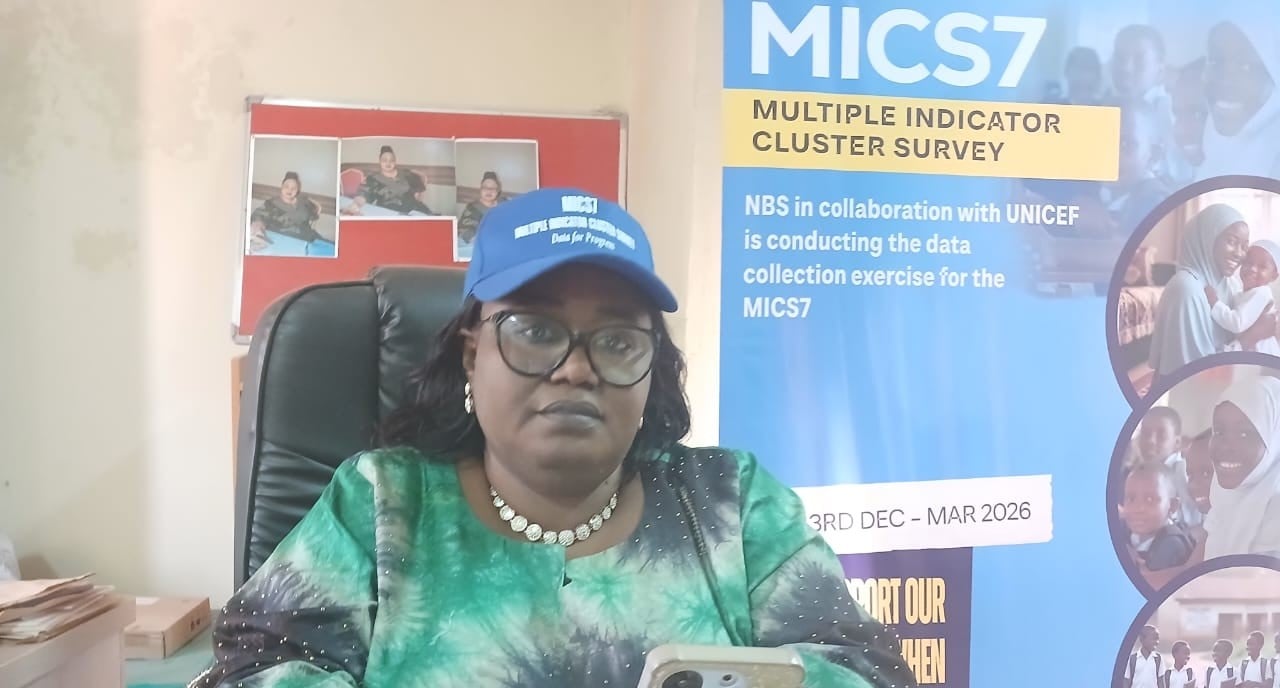
The National Bureau of Statistics in Gombe State on Thursday said the ongoing Multiple Indicator Cluster Survey (MICS 7) will generate credible, internationally comparable data to guide policy decisions affecting children, women, adolescents, and households across the state.
The State Officer of NBS, Elizabeth Augustine, said the survey, which commenced in December 2025, is expected to be completed by March 2026.
“MICS is a Multiple Indicator Cluster Survey that wants to know more about children, women, men, and adolescents, their welfare, their health, education and so on. That is all about MICS,” she explained.
According to her, the exercise is facilitated by the Federal and State Governments in collaboration with the United Nations Children’s Fund (UNICEF) and other partners.
In Gombe State, Augustine disclosed that 50 Enumeration Areas (EAs) are being covered across all local government areas.
“In Gombe State, as one of the participating states, we have 50 EAs to cover. Though we have two teams, each team comprises six personnel: a supervisor, three female interviewers, one male interviewer, and a measurer,” she said.
She added that each EA is expected to interview at least 20 selected respondents drawn from a previous listing.
“So now the work is in progress. Based on reports, some teams are already in their 15th EA,” she noted.
Augustine described MICS as a comprehensive survey with over 200 modules covering critical sectors.
“In MICS we have over 200 modules. Those modules consist of health, education, dietary intake for children under five, and functionality tests like reading exercises for adolescents aged 7 to 12 years,” she said.
She explained that children under five are measured for weight and height, while detailed questions are asked about their dietary intake.
“We measure all children under five their weight and their height and we also ask about all the dietary intake the children usually take. MICS wants to know about it just to make policy for the government to see where to intervene,” she said.
The survey also covers maternal and antenatal care.
“In women’s questionnaires, we ask whether during pregnancy of the last born, aged 0 to 23 months, the woman went for antenatal care or not. These questions will help to formulate policy about women and how to intervene in antenatal and postnatal care,” she added.
On education, Augustine said the survey seeks to determine school enrolment and dropout rates.
“We want to know early childhood education, how many are privileged to go to school and how many are out of school. We also have ICT modules to assess computer knowledge,” she said, noting that MICS 7 is more extensive than previous rounds.
The acting Gombe State Statistician, Ibrahim Abubakar, emphasised the importance of the survey to the state’s development planning.
“The importance of MICS to Gombe State can’t be overemphasised in terms of data. It provides credible data which is even internationally comparable on the well-being of children, women and households,” he said.
He described the survey as a rich source of information that would support informed decision-making.
“It’s very rich data that, after collection, will give informed data for policy making and decision making to the higher authorities, maybe the government and any data user,” Abubakar stated.
He noted that the Bureau is fully involved in the process from planning to fieldwork.
“From the planning stage to the end, Gombe State Bureau of Statistics is fully involved, from planning meetings through the selection of enumerators and field agents to the training and the main data collection work that is ongoing in the field,” he said.
Abubakar further explained that MICS is conducted every five years to track changes in key indicators.
“Normally, it is conducted after five years. You collect the data, analyse it, validate it, disseminate it, and after five years, the indicators must have changed, so another survey is conducted. The last one was 2021–2022, and this one is ongoing now,” he said.
He added that the data generated from MICS is used to track Gombe State’s 10-year development plan.
“There are indicators that we need to track towards our 10-year development plan in Gombe. Especially MICS, we use those indicators to track that development plan because it informs government decisions that affect the lives of children and women in terms of nutrition, health and education,” he explained.
Abubakar also highlighted that findings from previous surveys have influenced policy direction in the state.
“After collecting and disseminating the data, we prepare executive summaries for policymakers. It is based on that summary that they are able to make decisions. You can see in Gombe State that His Excellency is putting more resources into health and education,” he said.
Also speaking, Abdullahi Adamu, the NBS Zonal Controller, commended UNICEF and other development partners for their sustained support.
“We can’t thank UNICEF and other partners enough for their intervention. Now we are on MICS 7. It started from MICS 1, and I joined as an interviewer in MICS 4. Today, I am a Zonal Controller,” he said.
The officials expressed optimism that MICS 7 would further strengthen evidence-based planning and improve outcomes for children, women, and vulnerable groups in Gombe State.
Copyright PUNCH
All rights reserved. This material, and other digital content on this website, may not be reproduced, published, broadcast, rewritten, or redistributed in whole or in part without prior express written permission from PUNCH.
Contact: health_wise@punchng.
