

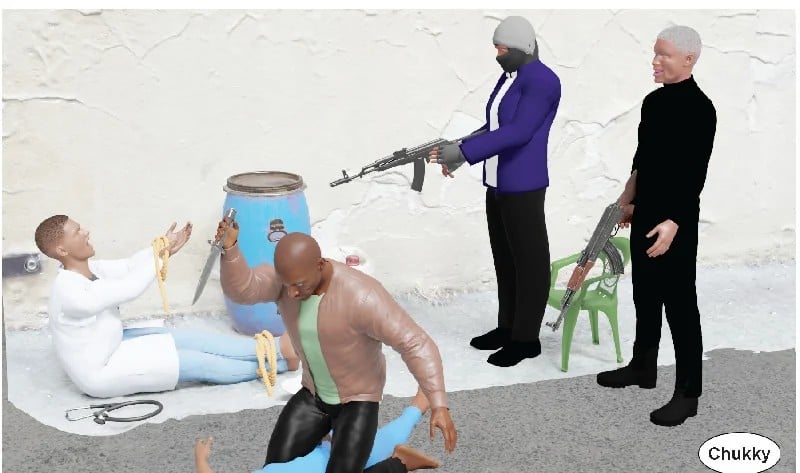
Across the country, healthcare workers, who have devoted their lives to saving others, are now living under the shadow of fear. Once regarded as neutral lifesavers, they are increasingly being hunted, abducted and, in some cases, brutally killed by non-state actors. From remote rural clinics to major urban centres, the stethoscope has become a target. This grim trend is deepening anxiety within an already fragile health system, stretching morale to breaking point and fuelling fears that the violence could worsen brain drain in the sector, as more professionals weigh survival over service, writes VICTOR AYENI
For the Jegede family, June 23, 2025, is no longer just another date on the calendar. It is now seared into memory as a Black Monday, one defined by pain, shock and irreparable loss, following what befell Wale, the family’s lastborn, on that fateful morning.
Saturday PUNCH gathered that, like many Mondays before it, the day began as part of Wale’s familiar routine.
The 32-year-old, who resides in Abuja, left home at dawn to report for duty at a hospital in Gwarimpa, where he worked as a physiotherapist.
This routine had remained unchanged since 2018, when Wale relocated from Lagos, where he was born, to the Federal Capital Territory in search of stability and purpose.
Widely known among friends, colleagues and patients for his empathy, warmth and disarming friendliness, he was the kind of caregiver whose presence alone often brought comfort to those in pain.
Wale’s journey into the medical profession was shaped as much by loss as by perseverance. In February 2013, he lost his mother to cancer, a tragedy that left a deep imprint on his young life. Before eventually gaining admission to the University of Lagos, where he graduated, he had twice attempted, without success, to study Medicine and Surgery at a federal university in Kwara State, his state of origin.
About five years after his mother’s death, fate struck again, claiming his father. The compounded grief, coupled with years of personal struggle, was said to have strengthened Wale’s resolve to dedicate his life to healing and touching lives in meaningful ways.
Living in an estate at the Zone E Extension of Apo Resettlement, Wale built a modest but purposeful life in Abuja, where he lived and worked for about six years.
Whenever work allowed, he travelled to Lagos to spend time with his elder brother, Seun, and his elder sister, Omotola, a family tradition that remained central to his life, even from a distance.
‘They macheted him to death’
At about 10 pm on June 23, Wale was said to have finished his shift at the hospital and got into his roommate’s light green Toyota Corolla to head home, a journey that usually took about 30 minutes.
While driving, his phone reportedly rang persistently as a friend staying with him and concerned neighbours tried to reach him, sending messages urging him to stay away from the estate.
At the time, gunmen, said to be more than 20 in number, had raided the estate where Wale lived and, according to a source, began hurling large stones in an attempt to force their way into some apartments.
Saturday PUNCH gathered that Wale could not take calls while driving and apparently did not see the warning messages before he arrived at the estate and fell into the hands of the bandits.
The source disclosed that the gunmen accosted Wale, forced him out of the vehicle and attempted to kidnap him.
In a video clip of a testimonial recorded on an online Christian platform, Streams of Joy International, and forwarded to Saturday PUNCH by Seun, Wale’s brother, one of his neighbours recounted the grisly details of the medical professional’s final moments.
According to him, he usually worked out at the backyard of his compound on Monday nights, but on that particular night, he felt unusually weak.
“Normally, I would motivate and push myself through, but I decided to go and have my shower instead. My bathroom window faces the estate gate, so while I was having my shower, I heard some noise from outside. I turned off the tap and peeped through the window to see what was happening.
“It was my neighbour, a young medical professional. He was outside, pleading with a group of about 20 men armed with heavy weapons. He had just returned from work and was about to enter the gate.
“What I was hearing was, ‘Please, you can take my phone, you can take my money and the car, but please don’t hurt me, don’t take me.’
“While he was on his knees, one of them said, ‘You no wan move, ba?’ Then he brought out a machete and struck him on the head, but he raised his hand to block it, and the machete cut his hand. Another blow split his head open, and they kept macheting him,” he said.
The man recounted that after Wale fell to the ground, motionless, the bandits began firing gunshots in different directions, forcing him and his roommate to lie flat on the floor and switch off the lights in their apartment.
Police intervention
According to the police, officers responded to a distress call from a motorcyclist around 10:30 pm on the night of the attack.
“Police officers engaged the armed robbers in a shootout, during which three persons sustained injuries. One of the victims later died in the hospital. A vehicle belonging to one of the victims was recovered from the scene,” the FCT Police Public Relations Officer, Josephine Adeh, said.
Seun told Saturday PUNCH that the family was informed by the police that when officers arrived at the scene and heard the sound of the ammunition used by the bandits, they realised the attackers were “more sophisticated than them, so they could not approach the scene for almost three hours, otherwise the officers could be killed.”
“It wasn’t until teargas was deployed that the bandits left the area. After that, the officers moved in, and that was when Wale was found in a gutter where the gunmen had pushed him. They said he saw the officers and then collapsed because he had lost too much blood and was already in shock,” he said.
On September 9 last year, operatives of the FCT Police Command attached to the Anti-Kidnapping Unit launched a follow-up operation targeting the gang responsible for the armed attack at Zone E Extension on June 23.
“Intelligence revealed that the gang had crossed from the Nasarawa forests into the FCT through the Karshi axis, with plans to launch another deadly attack. Acting swiftly, the command’s operatives traced them to a hideout at Kurape Hills, where they were planning a fresh operation.
“On sighting the police, the suspects opened fire, but the gallant officers engaged them in a fierce gun duel. The gang leader, identified as Umar Manu, also known as ‘Small’, was neutralised, while others escaped with suspected gunshot wounds,” Adeh said in a statement.
Family grapples with grief
Although the leader of the gang that brutally murdered Wale was neutralised by the police, this has done little to ease the deep sense of loss the Jegede family continues to grapple with.
“I have not recovered from Wale’s death,” Seun told Saturday PUNCH. “I developed hypertension after the incident and almost had a stroke. I keep seeing Wale, and I was only recently discharged from the hospital.
“That’s why I can’t say much about the incident even now, because I don’t want to trigger another episode. Wale was such a lovely person who dedicated his life to helping others. I still can’t move on because his passing changed everything.”
‘He was my baby’
Also speaking with Saturday PUNCH, Wale’s elder sister, Omotola, said the void left by his murder could never be filled.
“He was my baby,” she said. “I used to call him my first child because I was seven years older than him and his immediate elder sister, so he was practically born in my hands. I took care of him from childhood until the time of his death.
“I would say we were the closest siblings, and his death shook me deeply. If someone had told me last year that I’d be able to function normally now, I would have denied it. I just wish Nigeria were a place where accountability mattered to the government.
“I wish our lives counted more and that authorities would be motivated to catch those responsible for this heinous act. It was such a senseless murder; they could have taken anything he had, but they took his young, promising life. I hope they track down everyone involved, from those who supplied the guns to those who sent them on this mission.”
Nurse killed after shift
As the clock struck midnight and Nigerians welcomed 2026 with hopes of new beginnings and the realisation of long-held dreams, Chinemerem Chuwumeziem, a nurse at the Federal Medical Centre, Jabi, Abuja, embraced the new year with optimism.
Dedicated to saving lives, the 28-year-old, who worked in the VIP wing of the hospital, had her own dreams for the months ahead. Tragically, those dreams now lie unfulfilled.
A graduate of Madonna University, Chuwumeziem’s life was violently cut short, leaving her family, friends, and colleagues to grapple with yet another senseless loss in the healthcare profession.
After completing her NYSC in Ondo State in 2023, she relocated to the FCT and joined FMC Abuja in 2025.
Within the year, she quickly distinguished herself through her dedication, compassion, and cheerful nature, earning admiration from colleagues and patients, and was named Best Nurse of the Year 2025 at the hospital’s awards programme.
On the evening of January 3, Chuwumeziem completed her afternoon duty and left the hospital at 6:13 pm, as captured on the hospital’s CCTV, according to management. That was the last time she was seen alive.
Saturday PUNCH gathered that the nurse, who hailed from Orlu, Imo State, lived with her aunt in Wuse, about 20 minutes from the hospital. She is believed to have boarded a vehicle operated by “one chance” robbers on her way home that fateful evening.
Early the next day, her family raised the alarm when she had not returned home and could not be reached by phone.
The hospital reportedly mobilised staff to search nearby areas and hospitals but found nothing. Subsequently, the hospital alerted its Chief Security Officer, who contacted security agencies.
The police later discovered her body around the Bolingo Hotel Junction and took it to the mortuary. Recovered at the scene were her bag, containing personal items, including a Bible, while her phone was missing. The police reported that the cause of death was asphyxiation.
“Her family buried her in Imo State. The incident was reported to the Federal Ministry of Health, the Department of State Services, and the police, who have assured the hospital that investigations are ongoing to identify those responsible,” the Medical Director of FMC, Prof Saad Ahmed, told the News Agency of Nigeria.
Ahmed said measures were being taken to support staff and reduce risks, including reviewing shift schedules, improving the hospital shuttle bus system, and enhancing staff safety arrangements.
Calls for justice
Chuwumeziem’s brutal murder triggered widespread mourning at the hospital and among friends on social media, who lamented the loss of someone described as a passionate caregiver with a promising future.
The Head of Nursing Services at FMC, Mrs Abigail Gwimi, described the deceased as gentle, dutiful, and deeply committed to patient care.
“The killing has heightened fears among nurses and healthcare workers who often work long shifts and commute late, affecting morale and creating anxiety about personal safety,” she noted.
Reacting to the incident, the Chairman of the National Association of Nigerian Nurses and Midwives, FCT Council, Jama Medan, condemned Chuwumeziem’s unjust and brutal killing.
He noted that she “spent her day rendering selfless service to humanity and saving lives,” and described the attack as a “wicked and senseless act” that was “not only an assault on the nursing profession but also on healthcare workers and humanity at large.”
“We hereby call on the entire security architecture in the Federal Capital Territory, including the Nigeria Police Force, the DSS, and the Nigeria Security and Civil Defence Corps, to immediately conduct a thorough, transparent, and professional investigation into the circumstances surrounding her death and ensure the perpetrators are identified and brought to justice without delay,” Medan said.
He further highlighted that the “continuous harassment and attacks on nurses have exposed the alarming level of insecurity faced daily by healthcare workers, particularly while commuting to and from duty.”
Endangered healthcare workers
Amid Nigeria’s worsening insecurity, many healthcare workers, especially doctors, nurses, and pharmacists, have become targets of kidnappers, terrorists, armed robbers, and other non-state actors.
Findings indicate that criminal gangs often perceive health workers as financially stable, assuming they earn regular salaries, carry cash or valuable phones, and can quickly raise ransom through family or professional networks.
Moreover, healthcare workers often work long and irregular shifts, commute late at night or early in the morning, and travel predictable routes between hospitals and their homes.
Saturday PUNCH gathered that these patterns make surveillance easy for criminals, particularly in urban centres, turning health workers into soft targets.
Criminals also exploit broader security gaps in the country, including inadequate police presence, poor street lighting, limited CCTV coverage, and slow emergency response, to abduct, assault, and attack medical professionals.
The World Health Organisation estimates that between eight and 38 per cent of healthcare workers will experience violence at some point in their careers.
A 2020 study on workplace violence against healthcare workers reported that Nigeria has a prevalence rate of 31.9 to 78 per cent.
Experts warn that such attacks can affect health workers’ performance, reduce the quality of care, cause physical injury or death, and influence decisions to quit, thereby increasing the cost and difficulty of accessing healthcare.
“Every day, we see reasons to question our choice of profession, and with these incidences of doctors and nurses being killed, I don’t expect many more doctors to remain in Nigeria,” said a physician, Dr Fabian Aniorji.
Brain drain deepens
While physical attacks on healthcare workers are on the rise, Nigeria’s health sector is also struggling to retain its professionals amid a mass exodus.
Driven by poor working conditions, low pay, and insecurity, 4,193 doctors and dentists left Nigeria for greener pastures in 2024, according to the Nigeria Health Statistics Report released by the Federal Ministry of Health and Social Welfare in November last year.
The report indicated that migration of health workers surged by 200 per cent across all cadres between 2023 and 2024.
In May 2023, the National Association of Nigerian Nurses and Midwives revealed that over 75,000 nurses and midwives had left the country over five years in search of better opportunities.
The association cited insecurity, particularly the rising cases of kidnappings and violence against its members at work, as a major factor in the exodus.
Matron, consultant murdered
While many citizens expressed outrage over the murder of nurse Chinemerem Chuwumeziem, an X user, Gift Nwunye, recalled a similarly tragic incident involving her mother.
“She had several machete cuts on her and was dumped in front of our gate on November 3, 2025. She was a chief matron at a government parastatal until her death,” Nwunye said.
She added that the case had been reported to the police, though she needed to consult her father and husband before sharing further details.
In another disturbing case highlighting the increasingly hostile environment for healthcare professionals, a consultant psychiatrist at the Federal Neuro-Psychiatric Hospital, Enugu, Dr Andrew Orovwigho, was murdered by gunmen.
The incident occurred on December 31, when the Delta State indigene was abducted in front of his home on Nnamani Street and shot by armed men.
He was reportedly shot in the leg and back, dumped in a bush, and later found and rushed to a hospital for urgent medical attention.
Confirming the incident, the Chairman of the Nigerian Medical Association, Dr Ndiokwelu Chibuzo, said, “Relevant top security agencies were engaged; however, he was later found alive on January 2. Sadly, despite efforts to resuscitate him, he died.”
Saturday PUNCH gathered that Orovwigho lived alone, while his family resided in the United Kingdom.
“His family are all British citizens, but he chose to serve his fatherland with his knowledge. That was why he stayed in Nigeria. He was my neighbour for 17 years. He was highly intelligent and resourceful,” a source revealed.
Recounting the tragedy, a neighbour who preferred to be called Lilian Oseni said, “He returned home late that evening, and as he got to the gate, these men ambushed him. It appears they had been waiting. That was how they kidnapped and later shot him. The last time I saw him up close was on Christmas morning when I was driving out, and he bade me farewell. I keep staring at his window, hoping to see at least a dim light, but all I see is deep darkness and silence. My heart is broken,” she said with a sigh.
Checks by Saturday PUNCH confirmed that Orovwigho was a member of the National Harm Reduction Technical Working Group, established by the Federal Ministry of Health to oversee and guide the implementation of national harm reduction programmes aimed at reducing the negative health and social consequences associated with drug use.
He was also a key figure in developing and localising harm reduction strategies and guidelines in Nigeria, particularly those aligned with the United Nations Office on Drugs and Crime and the World Health Organisation.
Doctor siblings abducted, one killed
On January 1, Dr Tunde Abu, then on housemanship at Edo University Teaching Hospital, Iyamho, Edo State, was abducted alongside his younger brother, Tahir Abu, a newly graduated medical doctor from Ambrose Alli University, shortly after the close of work.
The duo were reportedly kidnapped at the gate of their residence in Igbira Camp, Auchi, the administrative headquarters of Etsako West Local Government Area of Edo State.
Initially, the abductors demanded a ransom of N200m for the brothers, but tragically, Tahir was killed on January 5, 2026, and his body was dumped beside a river.
Following this, the kidnappers continued to hold Tunde hostage, reducing the ransom to N100m, and after further negotiations with family members, it was finally lowered to N50m.
On Wednesday, an X page, Austin Jeff Blog, reported that Tunde was rescued by Auchi hunters and local vigilantes in a forest at about 8 p.m.
In a video shared by the page and viewed by Saturday PUNCH, men believed to be vigilantes assisted a man thought to be Tunde, who had difficulty walking, into a waiting vehicle after the rescue.
The state chairman of the Nigerian Medical Association, Dr Eustace Oseghale, confirmed the doctor’s release.
Last week, Oseghale condemned the kidnapping, stating that the incident highlighted concerns about the safety of healthcare professionals in Edo State and threatened effective healthcare delivery.
The NMA chairman in Edo North, Dr Ifijeh Patrick, also led a protest to draw attention from government officials, security agencies, traditional institutions, and other stakeholders to the growing threats facing healthcare workers.
“We save lives every day, yet our own lives are constantly under threat. We are no longer safe going to work or returning home. This must stop,” he said.
‘Governments must protect healthcare workers’
Commenting on the spate of insecurity against healthcare providers, the Executive Director of the International Human Rights and Dignity Defenders’ Forum, David Omeike, stressed that the protection of all citizens, particularly healthcare workers, is an obligation that federal and state governments must uphold.
He stated, “The failure to protect doctors and nurses not only violates their rights but also the rights of millions of Nigerians who depend on them. When doctors are unsafe, patients are unsafe as well.”
Omeike added, “It is a constitutional and moral duty of the state to protect them. Under the 1999 Constitution, the right to life and security is enshrined. The African Charter on Human and Peoples’ Rights, as well as the International Covenant on Economic, Social and Cultural Rights, affirm the right to health, which necessitates the protection of medical practitioners.
“The insecurity facing healthcare workers will accelerate the exodus of some of the best minds in the medical sector. Governments should secure healthcare workers in rural and high-risk areas, provide safe accommodation and official transport, especially for night shifts and emergency duties. Escorts or patrols should be made available where necessary.”
Curbing insecurity
A security expert, Armstrong Oyeyemi, told Saturday PUNCH that federal and state governments must prioritise security by strengthening intelligence gathering and early threat detection.
“Through community engagement, authorities should sensitise the public, especially health workers, on ‘black spots’ in urban areas and advise on areas to avoid. There should be awareness campaigns on detecting ‘one-chance’ criminals and the provision of technology-aided tracking devices in homes and workplaces.
“Clinics and hospitals must be well-lit, with adequate surveillance systems outside and inside the homes of at-risk medical staff. Streets need proper lighting, and police and vigilante groups must be better equipped. We cannot continue to sacrifice our best healthcare professionals to the menace of insecurity.
“These doctors and nurses are the people we rely on when attacked or injured, yet now they are being targeted. This is an urgent wake-up call for the government and security operatives to act decisively.”
Copyright PUNCH
All rights reserved. This material, and other digital content on this website, may not be reproduced, published, broadcast, rewritten or redistributed in whole or in part without prior express written permission from PUNCH.
Contact: health_wise@punchng.
