

Despite the Lagos State Government pouring billions of naira into water provision, many residents still cling to wells, boreholes, and sachet or bottled water to get by. UTHMAN SALAMI examines the cracks in the public water system—and the urgent fixes needed to make safe water a reality for all, in this investigative report
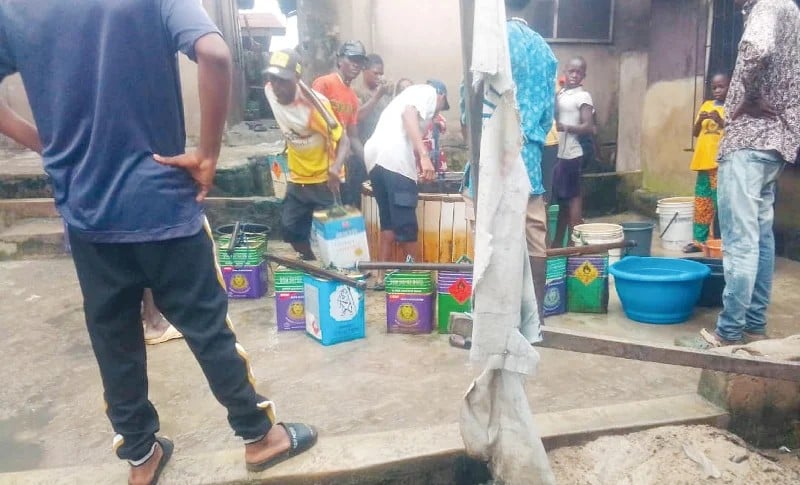
There was nothing unusual about the morning of November 12, 2025, in Owode-Orile. A thick blanket of fog hung over the community, so dense that it was difficult to see anyone standing just a few metres away. Yet, through the mist, the silhouette of a woman moved slowly, her arms rising and falling in a steady rhythm.
A few steps closer, the figure came into focus: a mother in her mid-thirties, Bola Thomas, with a baby tied securely to her back, repeatedly bending to draw water from a well.
She was not alone. At least seven other residents queued behind four people already taking turns at the water’s edge.
“This is nothing,” Thomas told this reporter. “This is the struggle we go through every day just to get water to our houses.”
For many residents, the well has become the only reliable source of water.
Located in Owode-Orile, close to the sprawling Mile 12 market—one of Lagos State’s busiest commodity hubs—the modest well serves more than seven neighbouring communities, including Ojajini, Ayenuwa, I Don’t Care Street, Adekunle, Balogun and Ladipo, as well as parts of Mile 12 itself.
What makes the situation even more striking is that all this is unfolding in Lagos—a state surrounded by water—yet one where residents struggle daily to access something as basic as potable water.
Over N66.934bn spent, no potable water
Despite emerging as the fifth-best African city for desirability to live, work and invest in, according to the Brand Finance City Index 2023, and with a projected 2026 budget of N4 trillion, a significant proportion of Lagos residents still rely on wells and boreholes for domestic use, and sachet or bottled water for drinking.
In the last six years alone, the Lagos State Government has poured billions of naira into water provision. Yet, residents continue to depend largely on self-supplied water to survive.
In 2020, for instance, the government spent N5.891bn as capital expenditure on waterworks. The following year, N1.950bn was earmarked for the advancement of Adiyan Waterworks Phase II and the rehabilitation of mini waterworks across the state.
According to the government, the “improvement of water reticulation and procurement of water chemicals” was also captured in the 2021 budget.
Spending rose further in 2022, with capital expenditure exceeding N2.510bn and total spending reaching N5.741bn. In 2023, N1.238bn was allocated for potable water provision, followed by N1.959bn in 2024. In 2025, a staggering N53.386bn was budgeted for water supply.
Yet, despite these figures, the impact on ordinary Lagosians remains negligible.
Many residents still depend on private boreholes, unhygienic wells, and sachet or bottled water—a stark reminder that the over N66.934bn spent in just six years has not translated into water flowing into homes.
SDG Goal 6
The United Nations’ Sustainable Development Goal 6 seeks universal access to safe water, sanitation and hygiene—critical pillars of public health and human well-being.
According to the UN, global water demand continues to rise, driven by rapid population growth, urbanisation, and expanding agricultural, industrial and energy needs. It reports that water demand has outpaced population growth, with water stress remaining at about 18 per cent since 2015.
One in ten people worldwide live under high or critical water stress, while several regions operate at over 75 per cent stress levels. The organisation also warns that climate change will further intensify water scarcity.
Achieving universal access to safe and affordable drinking water by 2030, the UN says, will require increased investment in infrastructure and sanitation, protection of water-related ecosystems, stronger hygiene education and improved water-use efficiency.
Similarly, the 2021 Water, Sanitation and Hygiene National Outcome Routine Mapping (WASHNORM) Survey Report states that tubewells and boreholes are Nigeria’s primary sources of drinking water, serving 37 per cent of the population. Unprotected dug wells account for 12 per cent, while protected dug wells and surface water each serve 11 per cent.
In the South-West, the pattern differs: about 35 per cent of residents depend on sachet water. Sachet water is also the main drinking source for 27 per cent of urban households and 35 per cent of the richest households.
Alarmingly, the report estimates that 34 per cent of households in Lagos rely on water contaminated with E. coli.
Lagos waterworks
According to the WASHNORM 2021 report, Nigeria’s installed waterworks capacity stands at 8,058,150 cubic metres per day, but actual operational capacity is just 1,975,073 cubic metres—about 25 per cent utilisation.
For Lagos, which aspires to be a true megacity, the picture is particularly grim.
Despite massive investments, major waterworks operate far below capacity, leaving millions to depend on unsafe alternatives.
The Isheri Oshun Waterworks, with an installed capacity of 16,720 cubic metres per day, records zero per cent utilisation. The larger Adiyan Waterworks, designed to produce 293,480 cubic metres daily, operates at just 4.21 per cent—about 12,342 cubic metres per day.
Even Iju Waterworks, the most functional of the three, operates at only 48.19 per cent of its 187,440 cubic metres daily capacity.
Compounding the problem is the lack of distribution infrastructure, which means that even when water is produced, it often does not reach households.
In Owode-Orile, elderly residents depend on Meruwa—water vendors—because they cannot draw water from deep wells themselves.
A resident, identified as Betty, explained the cost of survival: “If you cross to the other end of the road, the water sellers charge N300. Within this area, they collect N200 for one gallon. From Balogun to Alhaja Nimota Street, they take N300.
“This small well serves many communities—Ojajini, Ayenuwa, I Don’t Care, Adekunle, Alhaja Nimota, Mile 12 and Ladipo.”
Another resident, Samuel, recalled months-long power outages. “There was a time we had no electricity for a whole year. This year, we had light for six months, then it was taken again. It’s been over five months now. Without power, private water becomes impossible.”
The Chairman of Owode-Orile Landlords Association, Toby Agbede, was blunt: “I’ve lived here for over 30 years. Our problems are light and water—but water is the major one.
“We have one well serving more than seven communities. The owner said water should not be sold, so people fetch freely. But those who can’t draw water themselves pay the Meruwa. It’s their sweat.”
Agbede said politicians had repeatedly failed the community. “They come with surveys and promises, but nothing happens. Water is life. Even if it’s just a borehole, we’ll appreciate it.”
Community leader Adebayo Aderibigbe echoed the frustration. “This is an APC community. During campaigns, they promise boreholes and bring surveyors. After elections, they disappear.”
In I Don’t Care Street, a 60-year-old woman, Funmilayo, said: “The water is not drinkable. We use it for laundry and depend on sachet water to survive. To fill a drum now, the Meruwa charge about N2,000.”
Similar scenes played out in Captain, Abule Egba, and across Oreofe Close and Ebun Ayodele under Ilebukun LCDA.
CDA Chairman Luoso Emmanuel said, “We have no public water. We rely on private boreholes, and the water is not free. Government officials came once, promised, and vanished.”
A resident, Ibem, added: “Some boreholes are drinkable; others aren’t. We rely on sachet water. A 25-litre container is N100. Some water is so hard it’s only good for laundry.”
The struggle is echoed across Ikorodu and Alapere, where unreliable supply forces households into costly alternatives.
‘80% Lagos residents rely on self-supply’

Public affairs analyst Kolawole Banwo described Lagos’ water crisis as “hydra-headed.”
“Many waterworks are moribund. The system is too centralised, and when something breaks, it takes too long to fix,” he said.
He added that road construction has severed pipelines in many areas. “Even if water is produced, it won’t reach people. Some communities were never connected at all.”
Citing WaterAid research, Banwo said, “Eighty per cent of Lagos residents depend on self-supply.”
He questioned government spending: “If billions were spent, where did the money go? And did it translate into water for the people?”
Banwo criticised civil service delays, high non-revenue water—estimated at 40 per cent—and slow procurement of chemicals and equipment.
“We need decentralised, independent water utilities capable of cost recovery. Faults must be fixed immediately, and water must be safe,” he said.
Neglect pushing residents into danger
Philip Jakpor, Executive Director of Renevlyn Development Initiative, warned that lack of safe water is pushing residents into dangerous alternatives.
“Virtually all communities in Lagos lack pipe-borne water,” he said, describing the situation as a failure of governance.
Jakpor warned that indiscriminate borehole drilling damages groundwater and that surface wells are easily contaminated. “People use the same buckets for defecation and fetching water. This exposes them to disease.”
He stressed that the solution lies with government responsibility. “Pipelines must be properly laid. When they break, sewage gets in and causes cholera. It’s the government’s duty to fix this.”
Lagos govt reacts
The Commissioner for Information and Strategy, Gbenga Omotoso, acknowledged the challenges but said the government was working toward solutions.
“We have challenges. Are we doing something? Yes—a lot,” he said.
He disclosed that the Lagos Water Corporation had invited bidders for projects and that contractors would soon be appointed. He also cited the ongoing Adiyan Waterworks Phase II, expected to serve four million residents, and a new waterworks in Agege-Akilo projected to serve seven million people.
While the state government’s assurances persist, communities across Lagos continue to ask the same question: When will the pipes finally run beneath their streets, and water flow into their homes?
Copyright PUNCH
All rights reserved. This material, and other digital content on this website, may not be reproduced, published, broadcast, rewritten, or redistributed in whole or in part without prior express written permission from PUNCH.
Contact: health_wise@punchng.
