

Idowu Abdullahi
Ahead of the 2027 general elections, candidates from four political parties seeking to succeed Governor Babajide Sanwo-Olu of Lagos State have revealed plans to tackle the state’s waste crisis.
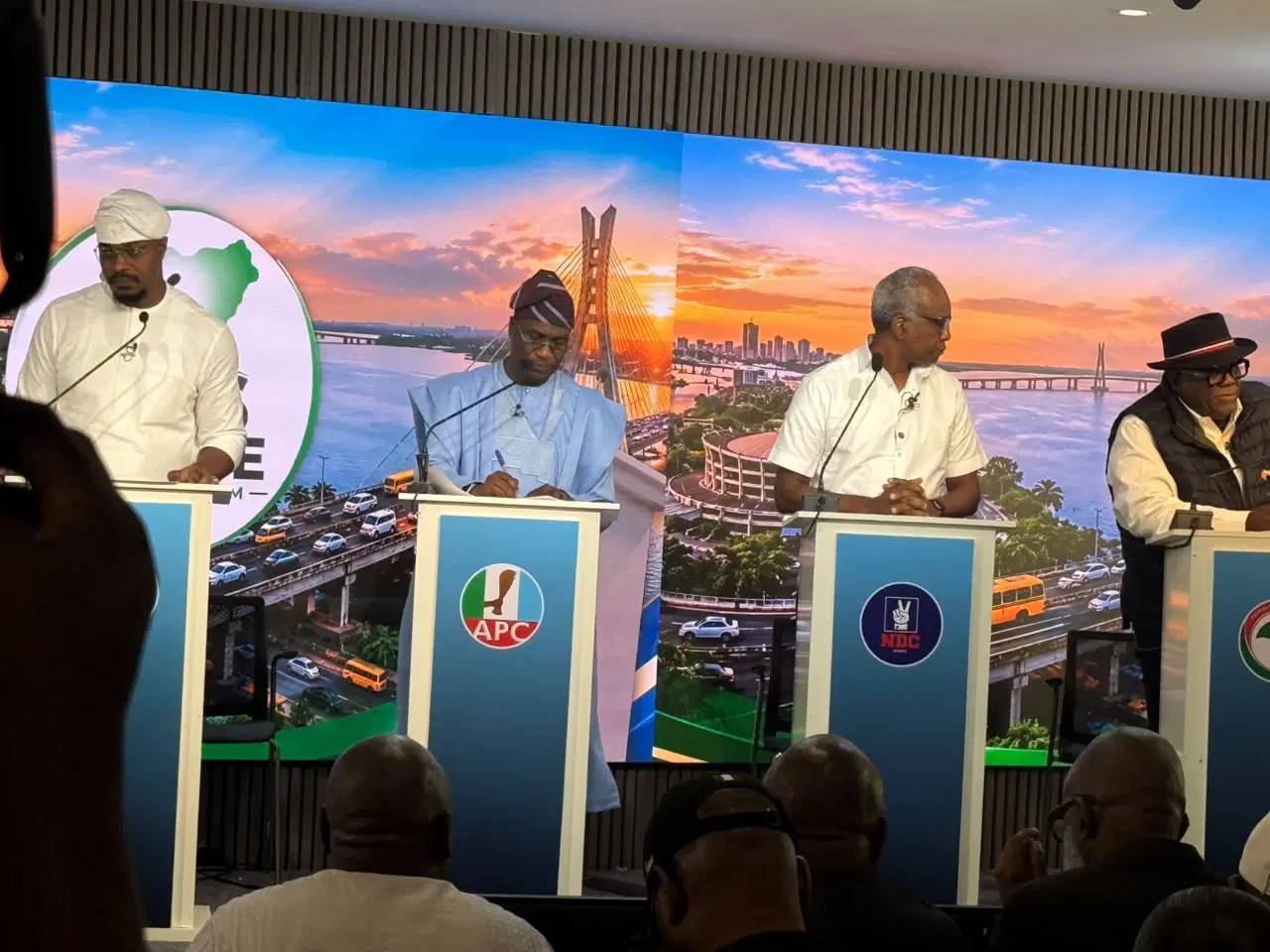
The governorship candidates of the All Progressives Congress, Dr. Obafemi Hamzat; the African Democratic Congress, Gbadebo Rhodes-Vivour; the Nigeria Democratic Congress, Funso Doherty; and the Peoples Democratic Party, Adedeji Doherty, shared their plans during the governorship debate on Sunday.
The debate was organised by the Nigeria Debate Consortium, a collaboration of five leading Nigerian media organisations made up of PUNCH Newspaper, Channels Television, TVC News, TheCable and Vanguard Newspaper.
Speaking at the debate, the candidates expressed divergent views on the causes and management of the state’s waste crisis, with some blaming poor governance and inadequate infrastructure, while others point to population pressure and limited landmass.
PUNCH Healthwise reports that there had been concern among residents that Lagos allegedly smells, with people sharing their experiences on different social media platforms.
In May 2025, a controversial influencer, Scott Iguma, had, in a viral podcast interview, claimed that “Lagos is smelling…There are a lot of big mosquitoes in Lagos.”
However, the Commissioner of Environment and Water Resources, Tokunbo Wahab, faulted the claim, insisting that some individuals are deliberately trying to tarnish the state’s image.
But while responding to the question on concerns raised by residents that Lagos ‘smells’ during the debate, some candidates admitted that some part of Lagos smells, stressing that waste management remained a major challenge in the state.
Speaking, ADC candidate, Gbadebo Rhodes-Vivour, said Lagos “stinks” while blaming the government’s response to complaints about environmental conditions.
“Yeah, Lagos stinks. And unfortunately, the response by the government to that has been to tell us, or tell Lagosians, to go back to where they came from,” he said.
Rhodes-Vivour disputed the argument that population growth was the primary reason for the worsening waste situation, pointing instead to what he described as a decline in the number of waste collection trucks.
He compared the situation with the administration of former Governor Babatunde Fashola, saying the state previously operated about 1,000 trucks, against the approximately 200 currently available, according to reports he receives.
“Unfortunately, under Governor Fashola, we were dealing with about 1,000 trucks. Currently, reports that I get indicate we are currently at 200 trucks. So this idea that Lagos is dirty because there are so many people coming into Lagos is false,” he said.
The ADC also criticised what he described as excessive centralisation of waste management, arguing that local governments had not been sufficiently involved in addressing the problem.
“We have a situation where the management of the system has been too centralized, without the local governments involved, and we have failed to create waste-to-wealth value chains and waste-to-energy value chains. We don’t actually have a waste management system; we have a waste pick-and-dump system,” he said.
On his solution, he proposed a decentralised arrangement in which LGAs would play a greater role, while households would be encouraged to separate waste before collection.
“Under my government, that will change. We are going to get the local governments involved, get the people at home to separate waste from the source, and have different routes for different waste to go to different places where value is created. The person who is separating their own waste benefits, the local government benefits, and the state government benefits,” Rhodes-Vivour said.
However, the APC candidate and current Lagos Deputy Governor, Dr Obafemi Hamzat, who rejected the ‘smelly’ claim, admitted that Lagos currently faces a waste management challenge.
He attributed the waste management challenge partly to the volume of waste generated by residents and the limited land available for disposal facilities.
“Lagos generates a lot of waste. An enormous number of people come into Lagos, and of course, they generate waste. What is happening is that Lagos has a small landmass, so it is difficult to expand waste sites,” he said.
On the solution, Hamzat said Lagos was moving away from a system focused mainly on collecting and dumping waste towards one that prioritised material recovery and the reuse of recyclable materials.
He identified Olusosun and Solous 3 in Alimosho as locations where the state was developing transfer loading stations, each with a stated capacity of 5,000 metric tonnes.
“What is happening right now is that we are converting from collection and dumping to collection and material recovery. If you go to Olusosun and Solous 3 in Alimosho today, we are building a transfer loading station that has the capacity to take 5,000 metric tonnes each,” he said.
Explaining the proposed approach, Hamzat said waste would first be collected and transported to transfer loading stations, where recyclable and recoverable materials would be separated before the remaining waste was taken to landfills.
“The strategy is to collect waste, take it to the transfer loading station, and perform material recovery so that what goes to the landfill is significantly smaller than what it is today. So if we are able to move about 10,000 tonnes of waste into recovery, then we will achieve the same thing across the board. It is about functionality,” he said.
On his part, the NDC candidate, Funso Doherty, acknowledged that some part of the state smells, while cautioning against generalising the condition.
He noted that some parts of Lagos were clean while others had serious waste challenges.
“As a Lagosian, it’s very difficult for me to admit that Lagos is smelling, but I’m sure parts of Lagos are smelling. We all smell the parts of Lagos that are smelling. Parts of Lagos are also clean, but we certainly have a waste management problem,” he said.
Doherty described the situation as a failure of governance, arguing that the state needed to address immediate waste collection challenges alongside long-term plans for recycling and converting waste to energy.
“Again, I would characterize this as a failure of governance. There are two aspects going on here. One is the long-term goal of recycling waste to wealth and waste to power; that must continue. But the efficient collection of waste currently being generated—whether converted to wealth or not—must be good,” he said.
He identified inadequate investment in waste collection trucks, receiving receptacles and transfer stations as some of the infrastructure gaps affecting the system.
“Part of the problem we have is that we don’t have sufficient investment in trucks, in receiving receptacles, in transfer stations, and so on and so forth. Again, this follows the pattern of government stepping back from the social sector and wanting the private sector to play the role, which it cannot do effectively,” Doherty said.
Similarly, the PDP candidate, Adedeji Doherty, described waste management as a critical issue requiring urgent attention, stressing that the volume of waste generated in a community should determine how frequently it was collected.
“The issue of waste is very critical—an issue that needs to be tackled head-on. The reality is very simple: if you are in a room and there are five of you, you might take out the trash twice a day. If there are 15 of you in the room, you definitely have to take out the trash maybe 10 times a day,” he said.
On the solution, he argued that the frequency of household waste collection and the number of trucks deployed across the state were inadequate compared with the volume of refuse being generated.
“The rate at which garbage is taken out from houses and picked up by trucks in Lagos State is definitely far below what should be happening,” Deji Doherty said.
He also stressed the need to distinguish between different categories of waste, including liquid, human and solid waste, arguing that each required appropriate management.
Raising concerns about the environmental condition of the Olusosun site, he alleged that the area was already polluted, with rodents thriving there and the soil contaminated.
“Apart from that, we have different types of waste: liquid waste, human waste, and solid waste. Regarding the site the Deputy Governor was talking about at Olusosun—Olusosun is already polluted. Rodents thrive there, and the soil is contaminated to the point where you have to dig 300 meters down before you can even get clean water,” he said.
PUNCH Healthwise reports that Lagos, with an estimated population of over 20 million, currently faces a waste management challenge.
Available data indicate that Lagos generates about 13,000 tonnes of waste daily, making it one of Africa’s largest generators of municipal solid waste.
Recently, managing the waste has remained a persistent challenge in Lagos as the Lagos State Waste Management Authority struggles to sustain waste evacuation efforts.
Across several communities, overflowing refuse bins, roadside dumps, and blocked drainage channels have become a common sight.
In many neighbourhoods, road medians and drainage channels have gradually been converted into unofficial dumping sites.
Amid growing concerns over the accumulation of refuse across the state, Sanwo-Olu, on June 18, ordered the immediate evacuation of waste across the state, yet the issue persists.
Copyright PUNCH
All rights reserved. This material, and other digital content on this website, may not be reproduced, published, broadcast, rewritten or redistributed in whole or in part without prior express written permission from PUNCH.
Contact: health_wise@punchng.
