

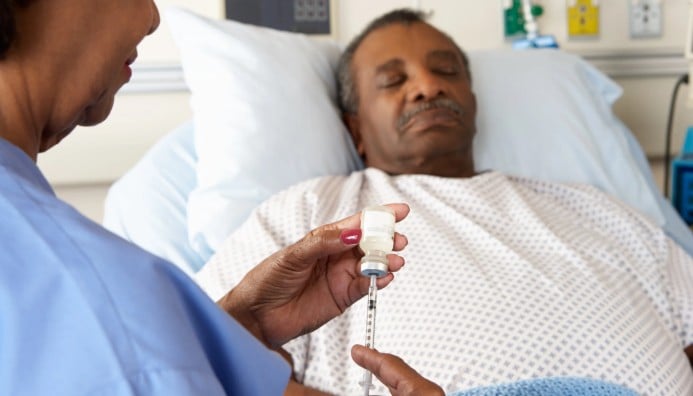
As more young Nigerians relocate abroad or move to urban centres in search of better opportunities, many elderly parents are being left behind without caregivers or adequate support systems. IDOWU ABDULLAHI writes that amid the partial implementation of the National Policy on Ageing, experts warn that the growing absence of family care is exposing vulnerable older persons to serious health risks, including missed early warning signs of illness, poor medication adherence, delayed hospital visits, worsening chronic conditions, and preventable deaths
When Olatayo received a call from Nigeria on a chilly but sunny afternoon in May 2025 in Sicily, Italy, it did not immediately seem like an emergency.
Her father, Odumosu Oladejo, had always appeared strong for his age. At 72, he still bathed himself, observed his daily prayers, and managed his hypertension and diabetes with support from his daughter abroad.
But within days, what started as a seemingly minor health issue for the Ogun State-based septuagenarian turned fatal.
According to Olatayo, she immediately instructed his caregiver to take him to the hospital after being informed that he was unwell.
“Instead, the caregiver whom I entrusted with his care invited an auxiliary nurse to the house against my instructions. There was no proper diagnosis or thorough medical examination; the nurse only administered drips and medications without understanding what was wrong with him,” she told PUNCH Healthwise.
Unknown to Olatayo at the time, her father had missed critical medications needed to manage his chronic conditions.
His feeding had become inconsistent, and his medications were not taken regularly due to the caregiver’s poor service.
Worse still, the truth about his deteriorating health condition was concealed from Olatayo.
By the time she was informed that a family member needed to be physically present, it was already too late.
“He died within a week of the first call. He died due to a poorly managed chronic condition, despite not lacking drugs and resources. I still blame myself for his death,” she said.
Died alone
The night was quiet in November 2025, the kind of stillness that settles over neighbourhoods long after the day’s bustle has faded.
Inside her home in Ibadan, Oyo State, a retired academic, Oluwole Aderemi, was alone, just as she had been on many nights before. But on that particular night, a medical emergency unfolded silently.
Those who knew the 74-year-old described her as disciplined and knowledgeable, a woman who had spent decades shaping minds in lecture halls.
In retirement, she remained independent, managing her health with the support of a paid part-time caregiver after her children relocated abroad. But age and illness often demand more than routine care.
“She had severe hypoglycaemia. Whenever she had episodes of hypoglycaemia, she was expected to take a glass of Coke or three cubes of sugar to stabilise her condition,” a relative told PUNCH Healthwise.
Hypoglycaemia, a condition marked by dangerously low blood sugar, often requires immediate intervention. For many patients, taking sugar promptly can reverse symptoms within minutes.
But in Aderemi’s case, time slipped away.
“She had the episode around 10 pm. Unfortunately, because she lived alone, she couldn’t reach the kitchen to get the Coke or sugar, and then she died.
She died because there was nobody there to help her. Her children were all living abroad, and the caregiver did not stay with her permanently,” the relative added.
The deaths of Oladejo and Aderemi are not isolated tragedies. Their stories reflect a growing reality in many Nigerian homes, where elderly people are left to manage serious health conditions in isolation.
Growing elderly population
Nigeria currently has about 10 million people above the age of 60 and approximately 6.5 million above 65 years, according to a 2022 World Bank estimate.
Projections from the National Senior Citizens Centre also show that the country is home to over 14.8 million persons aged 60 and above, representing about five per cent of the population.
For decades, elderly care in Nigeria was deeply rooted in strong family systems, where children and extended relatives provided daily support and companionship.
Today, however, that structure is gradually weakening, worsening the living and health conditions of many senior citizens.
Findings by PUNCH Healthwise revealed that across the country, a rising number of elderly people now live independently, often without consistent caregivers.
Experts attribute this shift partly to migration, as younger family members relocate abroad or move to urban centres in search of better opportunities.
The changing family structure has created significant gaps in the traditional support systems that once cared for older persons.
For elderly people living with conditions such as diabetes, hypertension, and cognitive decline, daily monitoring is often essential, a need that becomes difficult to meet when they live alone.
Compounding the challenge is the limited availability of structured elderly care services.
The World Health Organisation notes that older persons living alone are at higher risk of delayed treatment, medication errors, falls, and complications from chronic illnesses due to the absence of immediate assistance.
Nigeria currently has only a few functional geriatric centres, while home-based care provided by part-time caregivers remains largely informal, unregulated, and often unreliable for an ageing population with complex health needs.
As a result, minor medical emergencies increasingly turn fatal.
A 2024 study published in the journal Geriatrics found that about 65 per cent of older Nigerians with functional limitations reported unmet needs in activities of daily living.
Systemic gap
Healthy ageing plays a crucial role in achieving Sustainable Development Goal 3, which focuses on good health and well-being.
Across Africa, the number of elderly people is projected to rise from about 41 million in 2025 to over 100 million by 2050.
With Nigeria’s ageing population expected to grow significantly, experts warn that age-related non-communicable diseases and other illnesses will place additional pressure on the country’s already strained healthcare system.
Infrastructure challenges remain widespread, as most primary healthcare centres are not designed to accommodate elderly patients.
Findings by PUNCH Healthwise showed that many facilities lack basic features such as ramps, suitable seating arrangements, and systems tailored to the needs of older persons.
There is also a shortage of trained geriatric specialists, with only a few teaching hospitals offering structured elderly care programmes.
Although the Federal Government approved the National Policy on Ageing on February 10, 2021, during the administration of former President Muhammadu Buhari, with the aim of improving the welfare of older persons, five years later, the policy has yet to be fully implemented.
There are 15 focus areas in the national policy, covering health and long-term care, food and nutrition, emergencies and epidemics, and ageing and disabilities, among others.
While the National Senior Citizens Centre, a Federal Government agency under the Ministry of Humanitarian Affairs, Disaster Management and Social Development, was established to drive the policy and improve the quality of life of older citizens, full implementation, particularly in healthcare, remains largely in progress.
Dying from preventable causes
She died in silence, the kind of death that was preventable.
After retirement, 78-year-old Blessing Okojie’s once-busy life revolved around careful routines and the management of her diabetes and hypertension.
Earlier in life, Okojie built a career defined by service and structure, rising through the ranks to become a permanent secretary in one of the South-East states. In retirement, however, that structure gradually faded.
Her two children had relocated abroad, and like many elderly Nigerians, she relied on a caregiver who came during the day and left in the evening.
That arrangement worked until it didn’t. On a particular day in June 2024, she developed diarrhoea, a condition that can quickly weaken elderly people, especially without supervision or immediate medical care.
“She was stooling, but the caregiver thought she had done all she could and had to leave around evening,” a relative told PUNCH Healthwise.
Alone and growing weaker through the night, she struggled repeatedly to reach the toilet. With each trip, her strength gradually faded.
“On one of her repeated trips to the toilet, the old woman fell and remained in the same spot till the following morning. By the time she was found, she was lying in a pool of her own stool, dead,” the relative said.
What could have been a manageable illness turned fatal because help was absent at a critical moment.
“If there had been someone with her overnight, she wouldn’t have died. It was really heartbreaking,” the relative added.
Living in the past
Inside his quiet home in Osun State, where routines once flowed naturally, Ikuforiji Adewunmi now lives in fragments of time.
The 67-year-old retired policeman, once known to his children, had gradually faded into a version shaped by memory loss and confusion.
“My father has dementia, and over time, it has slowly taken pieces of him away. His memory, his sense of direction and his awareness of the present have all been affected,” his daughter, Orofunke, told PUNCH Healthwise.

What remains vivid to him, she explained, are memories of his youth and early adulthood, moments that now feel more real than the present day.
One of the most distressing aspects of his condition, Orofunke said, is his tendency to wander.
“He doesn’t just walk around the neighbourhood. He travels very far, sometimes trying to return to a farm he worked on decades ago. Whenever our neighbour calls to inform my siblings and me, our fear is always the same: what if this is the time he doesn’t come back? That fear never really leaves.
“And when he finally returns, tired and disoriented, and we ask him where he has been, his answers are always, ‘I went to see my brother’ or ‘I went to visit my uncle.’ But these people he refers to are no longer alive,” she said.
Orofunke said attempts to provide structured care have also come with challenges.
“At one point, we decided to hire a live-in caregiver for him, but within a week, food meant for my father was being taken away, meals were poorly prepared, and his medications were missed, which worsened his condition because of inconsistent care and support,” she said.
‘Money alone can’t solve it’
While remittances from abroad continue to support many families financially, experts warn that money alone cannot replace physical presence, especially for ageing parents with complex health needs.
They explained that older adults are particularly vulnerable because of a combination of medical and social factors.
Speaking exclusively to PUNCH Healthwise, a consultant geriatric social worker and gerontologist, Mr Olayinka Ajomale, lamented that the traditional system in which relatives and community members played active roles in caregiving is rapidly eroding.

According to him, migration, both within Nigeria and abroad, has significantly weakened support structures for elderly people managing health conditions.
He added that many families now rely on hired caregivers who are sometimes untrained or poorly supervised.
“People travel abroad to work in other countries. But in doing so, they leave their parents in the care of untrained or unqualified caregivers, or with relatives who may not have the skills or commitment required,” Ajomale said.
He stressed that for many elderly Nigerians, particularly those managing chronic illnesses, the absence of their children or a trained and dependable caregiver is not only emotionally difficult but also life-threatening.
Health battles
The gerontologist explained that older adults are especially vulnerable to multiple medical conditions occurring at the same time.
According to him, conditions such as hypertension and diabetes are highly prevalent among the elderly and often coexist, requiring constant monitoring and proper management.
“When diabetes is poorly managed, it can lead to several complications, including glaucoma and eventual blindness.
“Their immunity is also lower, so they are more susceptible to infections. Then we have mental health conditions like depression and dementia, which are becoming increasingly common,” he said.
Beyond illness, Ajomale noted that ageing also comes with physical decline, including reduced bone strength, slower reflexes and a higher risk of falls.
“A young person may stumble and regain balance, but an elderly person is more likely to fall and sustain fractures, and recovery is much slower. For a 20-year-old with a fracture, healing is usually well underway within three to four weeks. But for a 70-year-old, even after six to seven months, complications may still persist,” he added.
Aside from physical decline, Ajomale, who is the Executive Director of the Centre on Ageing, Development and Rights of Older Persons, said many elderly people also struggle with bladder control.
“Incontinence is bladder leakage. It is very common among elderly people and makes them unable to control their urine. For men, it may be linked to prostate issues. For women, it could result from urinary tract infections or other conditions. Many elderly people wear adult diapers when they go out.
“Bowel incontinence is more serious, though less common. It involves loss of control over bowel movements, often due to digestive system problems. But urinary incontinence remains the more common problem among elderly people,” he said.
Geriatric care in Nigeria inadequate — Experts
Experts specialising in the care of older adults have raised concerns over the state of geriatric care in Nigeria, describing it as inadequate and ill-equipped to meet the needs of the country’s ageing population.
They noted that the absence of structured elderly care programmes, limited specialist services, and poor integration of geriatric care into the healthcare system have left many older persons without the support needed to manage age-related conditions.
Speaking to PUNCH Healthwise, a seasoned geriatric physiotherapist, Prof Adetoye Oyeyemi, described geriatric care in Nigeria as inadequate, referencing the absence of structured programmes dedicated to older persons.
“We don’t have programmes that are truly dedicated to supporting or providing for the healthcare needs of elderly persons in Nigeria.
“In some developed countries, elderly people have health insurance that covers not only illnesses but also support for daily living activities. We don’t have that here. Everything is largely out-of-pocket,” he said.
Oyeyemi, however, emphasised the importance of preparing early for ageing by maintaining physical activity and paying attention to long-term health.
“People need to educate themselves early in life about what constitutes good health and well-being. Nigerians need to understand what to do later in life to prevent disability, impairment or functional decline.
“Once they take steps to delay or prevent these problems, they are already on the right path. People should not retire into inactivity. Staying active can delay many age-related conditions and improve quality of life,” he said.
On his part, Ajomale lamented that although the National Policy on Ageing has been approved, many of its provisions have yet to translate into meaningful improvements for elderly Nigerians.
He stressed that policy alone is not enough without political will and proper implementation.
“The framework is there, but what about implementation? Are the right people in place to drive it? In other countries, there are subsidies for transportation, housing and healthcare for elderly people, so they do not depend entirely on their children, who may also be struggling.
“Although it is not the responsibility of one group alone. Families, communities and government all have roles to play. It must be a multidimensional approach where we recognise older persons as a unique group and provide tailored solutions for their health, well-being and dignity.
“We will get there someday. But for now, the reality is that elderly people in Nigeria are on the disadvantaged side of life,” Ajomale said.
He also highlighted the need for greater awareness about ageing and its challenges.
“Care for the elderly is specialised. We need trained professionals, better education for families and a societal shift in how we view ageing,” he said.
Copyright PUNCH
All rights reserved. This material, and other digital content on this website, may not be reproduced, published, broadcast, rewritten or redistributed in whole or in part without prior express written permission from PUNCH.
Contact: [email protected]
