

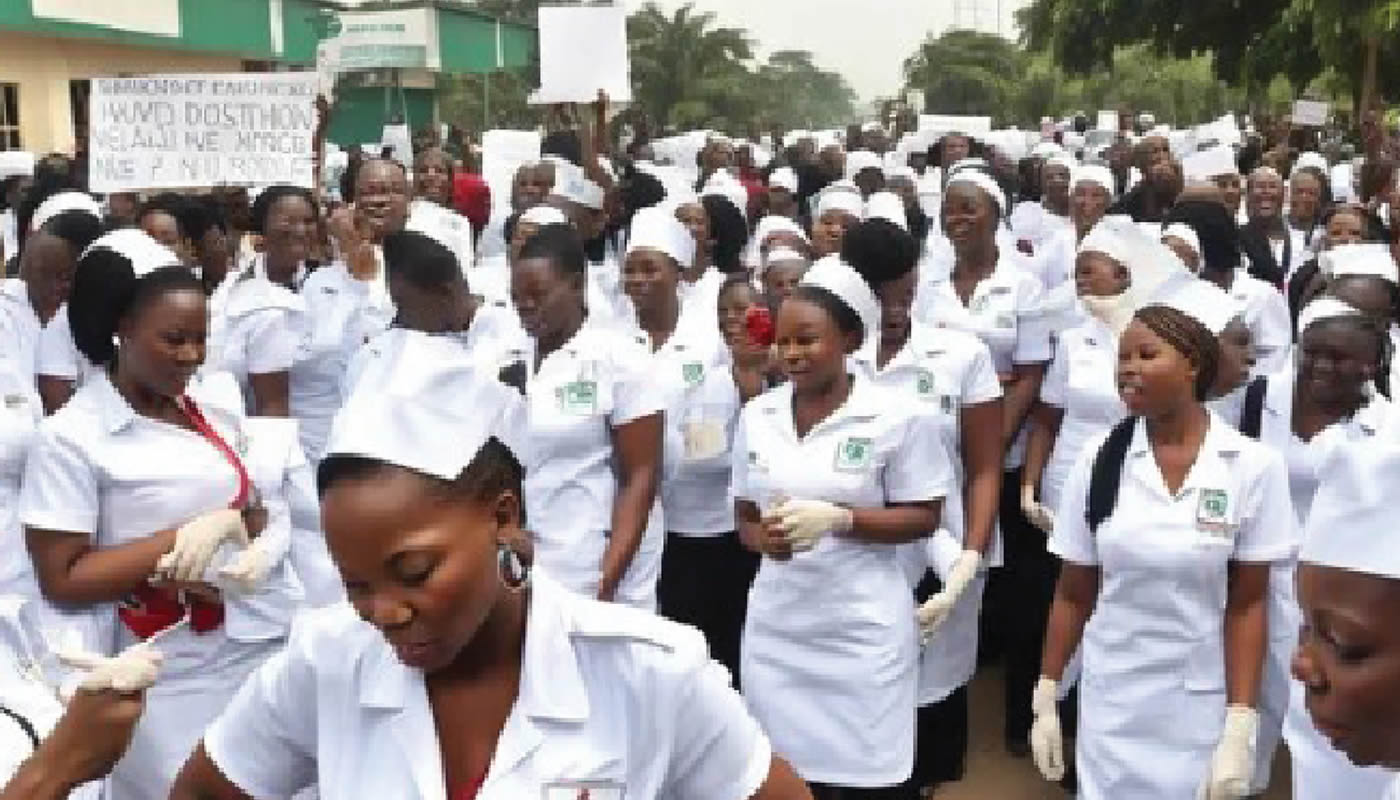
As the continued migration of nurses from Nigeria deepens the country’s healthcare crisis, resulting in longer waiting times, higher morbidity, and rising mortality rates in public hospitals, many nurses in Federal Government employment for over two decades still receive only N20,000 as annual uniform allowance, amid delays in the implementation of the N80,000 upward review. IDOWU ABDULLAHI reports
When nurses begin a shift in hospitals across the six geopolitical zones of Nigeria, the white uniform they wear symbolises care and professionalism.
From bed to bed, the nurses dress wounds, administer drugs, and monitor critically ill patients, often without rest or support.
Despite the lifesaving services they render, necessities such as maintaining clean uniforms, which are essential for infection control, have long been a personal burden for nurses.
For more than two decades, nurses in the Federal Government’s health institutions received just N20,000 allowance for uniforms annually, an amount many say could barely buy a single piece of workwear in Nigeria’s economic reality.
For Nurse Funmilola Faminu, the reality behind the white uniform she wears every day is far from symbolic.
On many days, she arrives at work before sunrise and may not leave until the following morning, yet she struggles with limited uniforms due to the N20,000 allowance.
“Wearing the same uniform for long hours is not ideal because it increases the risk of transmitting infections to patients.
“Sometimes we spend 24 hours at the bedside of patients,” Faminu, who works at the University Teaching Hospital, Ibadan, told PUNCH Healthwise.
In healthcare settings, experts say maintaining clean uniforms is not simply about appearance; it is a crucial infection control measure.
The experts explained that healthcare workers’ clothing can become contaminated with microorganisms during routine patient care, making many uniforms and regular laundering essential for nurses to prevent hospital-acquired infections.
But for years, Faminu and her colleagues across federal, specialist hospitals, medical centres, and clinics in MDAs in Nigeria received the same N20,000 uniform allowance despite soaring inflation and rising living costs.
The situation, among others, led to a nationwide strike that lasted a few days in July 2025, which crippled medical services across hospitals.
Some of the nurses’ demands during the industrial action were the upward review of shift allowance, uniform allowance adjustment, a separate salary structure for nurses, increased core duty allowance, mass employment of nurses, and the establishment of a nursing department in the Federal Ministry of Health, among others.
However, after more than 20 years of stagnation, in February 2026, the apex government approved an increase in nurses’ uniform allowance from N20,000 to N80,000 per year, an amount many nurses said was below par and uncertain they’d enjoy.
They argued that the new amount barely scratches the surface of their uniforms’ needs and the deeper problems confronting the nursing workforce.
Defined by inconsistency
For years, the N20,000 uniform allowance, often paid at the mercy of hospital administrators, has been irregular and unpredictable, undermining both professional welfare and morale.
Investigations by PUNCH Healthwise show that there is no documented or standardised mode of payment across these institutions.
It was gathered that hospitals’ chief medical directors or medical directors adopt different approaches to paying the allowance.
While some disburse the funds at the beginning of the year, others wait until they have surplus funds at the end of the financial year.
In some cases, it was learnt, payments are split into two separate tranches.
PUNCH Healthwise gathered that while some hospitals attempt to pay when possible, others simply do not pay at all, leaving affected nurses without the allowance they are entitled to by policy.
Stakeholders in the nursing profession decried the inconsistency, lamenting that the non-unified payment plans had denied many nurses their rightful allowance.
The President, National Association of Nigerian Nurses and Midwives-Federal Health Institutions Sector, Morakinyo Rilwan, explained that the uniform allowance is embedded in the Public Service Rule for nurses and firefighters alone.

“Some hospitals don’t pay this money. In fact, in over 70 federal health institutions — both teaching hospitals, medical centres, and specialist hospitals that we have in Nigeria — more than 70 per cent of them are not paying this money.
“And those who are paying the N20,000 pay it in installments to nurses where it is being paid. We have hospitals among those that are paying that owe nurses up to five or six years,” he told PUNCH Healthwise.
N80,000 not implemented yet
Compounding the issue is the fact that implementation of the new allowance has not yet begun, leaving many nurses waiting for the policy to translate into reality.
PUNCH Healthwise reports that the National Salaries, Wages and Income Commission, in a memo signed by the NSIWC Chairman, Ekpo Nta, approved an upward review of the uniform allowance to N80,000 from the initial N20,000.
The memo read, “Please refer to your letter No. C.2920/S.4/T2/33 dated 17th November 2025 in connection with the above-mentioned subject.
“I hereby convey approval for the implementation of the uniform allowance of N80,000 per annum for nurses in Federal hospitals, medical centres, and clinics in MDAs through the Integrated Personnel and Payroll Information System with effect from 1st January 2026.
“Consequently, the allowance will no longer be paid from the overhead budget in order to streamline the payment with other regular allowances payable through IPPIS.”
Although the commission said the implementation would take effect from January 2026, PUNCH Healthwise’s investigations reveal that payment has not started.
The NANNM–FHI president exclusively told PUNCH Healthwise that while the amount has been approved, nurses are yet to get payment across the country.
“As of now, we have yet to receive anything. We don’t even know the modality through which it will be paid, whether it will be monthly, quarterly, every six months, or paid at once annually,” Rilwan said.
We struggled with N20,000 uniform allowance – Nurses
For many nurses, the uniform is more than just clothing. It is a symbol of dedication to patients, even when the system that relies on their commitment struggles to fully support them.
Several nurses, who spoke with PUNCH Healthwise across the six geopolitical zones, lamented that while they are expected to look like angels, they are paid like scavengers.
Faminu, who works at UCH, lamented that for years, nurses received the same uniform allowance despite soaring inflation and rising living costs.
“The nursing uniform represents professionalism and purity. It also serves as a form of protection because nurses spend long hours caring for patients.
“The current economic situation in Nigeria makes it difficult for nurses to maintain clean and safe uniforms with that amount,” Faminu, who is the NANNM Chairman, UCH Unit, said.
Also speaking, a nurse at Federal Teaching Hospital, Gombe, Magaji Samaila, said nurses used their salary to augment the former allowance.
“In fact, this N20,000 has been there for more than two decades. Imagine the way our economy is not stable. Things keep changing, even in the market, but this N20,000 has been there right from time. Nurses end up using part of their salary to buy uniforms,” he said.
Samaila lamented that despite the hazards involved in their daily routine, they had to struggle for basics like uniforms.
“Our work involves getting in contact with patients with different kinds of health challenges. There are times you want to carry out procedures on a patient, whether a bed bath, wound dressing, or whatever.
“If you are not properly kitted, there may be a splash, and you need to go back immediately and change that uniform before you return to continue with your work, to avoid infecting other patients or complicating the splash on you.
“But because of a lack of money to get enough pairs of uniforms, the nurse ends up continuing to work with that contaminated uniform, which exposes the nurse to hazards,” Samaila added.
Also speaking, a nurse at the National Hospital, Abuja, Akpi Joseph, explained that nurses at the hospital were yet to get their 2025 uniform allowance.
“As I am talking to you now, we have not been paid the 2025 uniform allowance, which is still the N20,000 for last year.
“Our last year’s uniform allowance has not been paid. We started pursuing it around April 2025, and even recently, I was still at the Accounts Department trying to find out what was delaying the payment. So it has always been struggle upon struggle,” Joseph told PUNCH Healthwise.
N80,000 not the answer
However, the nurses told PUNCH Healthwise that while the previous allowance made it nearly impossible to maintain several sets of uniforms, the new N80,000 allowance is still insufficient with the current economic reality.
While commending the apex government for the upward review, they claimed the approved amount is not the answer.
“We appreciate the increase, but in the present economic situation of Nigeria, we cannot maintain clean uniforms to prevent infection towards a patient and ourselves at the current rate of N80,000 that has been approved,” Faminu said.
Also speaking, the NANNM-FHI National Secretary, Agatha Osinachi, said the newly approved amount won’t get a nurse the needed uniforms for a year.
According to her, to even work effectively as a nurse, you should have a minimum of three pairs of uniforms for a week.
“To even make a pair of uniforms, if you go around now, it is about N60,000 to make a complete uniform. Your shoe is not even included. To get a good shoe now, you should budget about N50,000 or thereabouts.
“And that’s me just talking about the basics. If you now start talking about scrubs, the cap, and the crocs we wear, N300,000 is not even enough,” she said.
Osinachi, who works at the Nnamdi Azikiwe Teaching Hospital, Nnewi, Anambra State, said part of the quality of a good nurse was to look smart.
She said, “You cannot go and meet the patients you are attending to while looking unkempt. We all go to the same market, and they know the cost of things today.
“So approving N80,000 as uniform allowance is what we don’t really understand. In fact, it is not palatable, and it is not acceptable to us.
“The Federal Government should do better and treat nurses as first-class citizens, not as an afterthought. Nurses are the ones doing the major work.”
Below requirement – Advocate
A health advocate, Barrister Ayo Adebusoye, said the newly approved amount was still below the requirement for nurses.

According to him, healthcare uniforms are not just clothing; they are part of the patient safety system.
Adebusoye, who is the Chairman, Board of Trustees of Public Health Sustainable Advocacy, explained that uniforms play a role in infection prevention because clinical attire must be washed frequently and maintained to reduce contamination risks.
“The increase is a step forward, but if we look honestly at the real cost of maintaining professional clinical attire, N80,000 annually may still be below what is required,” he said.
Adebusoye noted that if institutions require a professional dress code, they should support the cost of maintaining it.
“If the system can support wardrobe allowances for political offices, it should certainly support the professional attire of the nurses who sustain our health system.
“Nurses work long shifts, often in demanding conditions, and their uniforms must be cleaned and replaced regularly to meet infection-control standards. Supporting that requirement is therefore not a luxury but a patient-safety investment,” he said.
A profession under strain
Beyond allowances, nurses say their biggest challenge is the growing shortage of personnel in hospitals across the country.
Over the past decade, Nigeria has experienced a significant migration of healthcare professionals, a phenomenon popularly referred to as the Japa syndrome.
Countries such as the United Kingdom, Canada, Australia, and the United States have become major destinations for Nigerian nurses seeking better pay, improved working conditions, and career advancement.
According to data from the Nigerian Nursing and Midwifery Council, over 75,000 Nigerian-trained nurses and midwives are reportedly working abroad.

Also, the 2021 State of the World’s Midwifery report puts the midwives shortage in Nigeria at about 30,000, which is six per 10,000 people.
The report, as at then, also showed that 13,656 nurses and midwives educated in Nigeria were practising in the UK.
Against the backdrop of the WHO’s doctor-patient ratio (1:500), Nigeria has a 1:10,000 ratio, and 1:1,160 for nurses, as against the global standard of 1:5.
The result is an increasingly strained workforce back home.
PUNCH Healthwise’s findings revealed that these mass exoduses of nurses to seek greener pastures abroad have left several hospitals with fewer nurses to attend to patients below the benchmark set by the World Health Organisation.
Despite the WHO recommending one nurse to four patients, it was gathered that a single nurse may juggle between 20 and 40 patients daily in Nigeria.
The NANNM-FHI president said, “Ideally, what is recommended is about one nurse to four patients, and about 83 nurses to 10,000 population. But considering the japa syndrome now, instead of it being like 1:4, we are having about one nurse to 100 patients.
“But you find out that in a ward, you see a nurse attending to 30 to 40 patients in a shift. And because of this shortage, and the security situation in Nigeria, in most places, nurses don’t run three shifts anymore. They run two shifts, each of which is 12 hours.
“So you can imagine one nurse taking care of 40 patients for 12 hours. So it is that bad. That’s why you see nurses collapsing and some of them falling sick every time. The burnout is there. And these tolls are not commensurate with what we are earning.”
Across hospitals nationwide, Nigeria still has far fewer nurses than required for its population.
An executive member of the National Association of Nigerian Nurses and Midwives, who did not want his name in print, told PUNCH Healthwise that Nigeria’s nurse-to-patient ratio is alarmingly high.
He disclosed that the country currently has a ratio of one nurse to 1,160 patients, far from the WHO’s recommended ratio of one nurse to four patients.
“We currently have a ratio ranging from one nurse to 1,135 patients to one nurse to 1,160 patients in Nigeria. This is totally unacceptable and falls short of global health standards. The country already had a significant shortage of nurses even before the rise of the japa syndrome, yet we are still being owed uniform allowances,” he said.
Mental health experts have warned that nurse burnout not only affects workers; it can also compromise patient safety.
A Consultant Psychiatrist, Dr. Sunday Amosu, explained that burnout is characterised by emotional exhaustion, fatigue, and reduced job satisfaction.
These factors, he said, may increase the risk of medical errors.
According to him, chronic understaffing is one of the most significant drivers of burnout among nurses globally.
The situation in Nigeria, the psychiatrist said, was compounded by poor infrastructure, limited equipment, and difficult working environments.
“If you look at it, all of this will lead to psychological challenges and emotional issues, including burnout and emotional exhaustion. And if there is emotional exhaustion and burnout like this, then job satisfaction and job performance will go down.
“Statistically, all over the world, about 50–56% of nurses experience burnout, while about 64% are going through one form of stress or another. There are also physical health problems caused by the nature of their duty,” he told our correspondent during an earlier interview.
Price nurses pay
Meanwhile, the nurses say they often struggle to provide optimal care because essential medical tools are either unavailable or insufficient.
“There are hardly enough resources in terms of equipment for nurses to work with. It makes work very difficult. We just have politicians who want to build buildings, but what will be used in the building will not be available,” a chief nursing officer, Solomon Danmori, told PUNCH Healthwise.
Across hospitals nationwide, PUNCH Healthwise gathered that the frontline workers have been victims of violence, with nurses sometimes bearing the brunt of patients or their relatives’ frustration over systemic failures.
Danmori, who works at the Ahmadu Bello Teaching Hospital, Zaria, noted that in recent times, nurses have also been targets of kidnappers and bandits.
“In the North-West here, nurses have become like an endangered species because of the incidence of banditry. We have had nurses being kidnapped.
“In some places, nurses cannot even go on night duty because of the possibility of kidnapping. We have had an incident here in Zaria. At the Tuberculosis Centre, nurses were kidnapped at work.
“In Kaduna, around one village some years ago, nurses were kidnapped at the workplace. And then when you go to Sokoto, all those places have that issue,” he said.
Corroborating Danmori, Osinachi said, “In my own unit, I don’t want to mention names for security reasons, but there have been cases of kidnapping of colleagues. Because of that insecurity, some people have resigned because they don’t want to risk their lives.”
Aside from insecurity, the nurses also explained that their colleagues now come down with ailments in the course of duty due to a lack of adequate uniforms and protective kits.
“It has happened several times. Recently, there was an outbreak of Lassa fever in the area where I work in Gombe. They are facing the challenge of the Lassa fever outbreak currently.
“So a lot of colleagues are being quarantined currently. They have been isolated as a result of exposure while working because they are not properly kitted. Fluids splashed on them, and they became contaminated.
“Some of them are currently in isolation, while some have been confirmed to have Lassa fever and are being treated. That shows how we are exposed to hazards as a result of poor kitting,” Samaila told PUNCH Healthwise.
Another concern raised by nurses is the disparity in welfare facilities within healthcare institutions.
In many hospitals, they claim doctors have access to call-duty rooms and lounges where they can rest between shifts.
The nurses, however, say such facilities are often unavailable to them despite spending equally long hours on duty.
“Despite spending long hours at the point of care, nurses often lack adequate welfare facilities that would allow them to rest properly.
“From common rooms to permanent facilities, many things are controlled that way. Nurses do not have those facilities where they can sit down and eat their food comfortably during duty,” Osinachi said.
While allowances and facilities matter, many nurses argue that the central issue remains remuneration.
The nurses told PUNCH Healthwise that their salaries do not reflect the intensity and complexity of their work.
Within the profession, several specialised fields require advanced training and additional responsibilities. These include critical care nursing, neonatal nursing, oncology nursing, and psychiatric nursing.
However, many nurses say the additional skills required for these specialities are not adequately recognised in salary structures.
“Another major challenge is specialty allowance. Nurses who specialise—for example, in anaesthesia, perioperative nursing, or intensive care nursing—are supposed to receive specialty allowances. But the allowance is very poor. After spending money to specialise, when you come back, they don’t even pay you the money properly,” Osinachi said.
FG defends implementation delay
Meanwhile, the FG has defended the delay in implementation of the newly approved uniform allowance for nurses, saying the reasons are not punitive in nature.
Speaking with PUNCH Healthwise in an exclusive interview, the acting Director of Nursing Division, Hospital Services Department, Federal Ministry of Health and Social Welfare, Oluwayomi Ale, explained that the implementation timeline is determined after completing necessary administrative work.

“Any review of allowances is done within established public service frameworks and through appropriate consultation mechanisms. Implementation timelines are usually determined after the completion of the necessary administrative and policy processes. Once all approvals are concluded, the relevant authorities will communicate the effective date through official channels,” she said.
Ale added, “Nurses play a vital role in healthcare delivery across the country, and the government recognises the need to continually review welfare packages in line with current realities. The upward review of the Uniform Allowance is part of ongoing efforts to ensure that nurses are adequately supported in the discharge of their professional responsibilities and to improve morale within the health sector.”
On Japa syndrome, the acting director said, “The migration of health professionals is a global phenomenon, but the government is taking steps to make the local health system more attractive. Improving welfare packages, strengthening working conditions, and investing in the health sector are part of broader strategies aimed at retaining Nurses in Nigeria.
“Government is aware of the pressures faced by nurses who are at the frontline of service delivery. Efforts are ongoing to address issues relating to welfare, workforce planning, and working conditions so that nurses can operate in a more supportive and productive environment.”
Ale stressed that the welfare of nurses remains a priority for the government, adding that the FG would continue engagements with relevant stakeholders to ensure that remuneration and incentives remain responsive to the needs of the sector.
Copyright PUNCH
All rights reserved. This material, and other digital content on this website, may not be reproduced, published, broadcast, rewritten, or redistributed in whole or in part without prior express written permission from PUNCH.
