

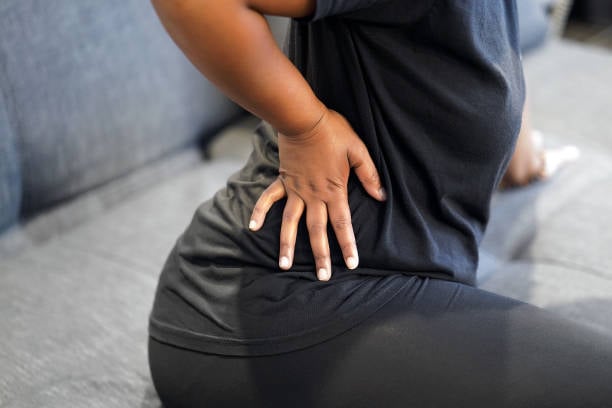
Complaints of persistent waist pain are common among many Nigerian women. While some can trace when the pain began, others have come to accept it as a part of daily life. Although waist pain, medically known as low back pain, affects both men and women, factors such as hormonal changes during pregnancy and menopause, childbirth, and lifestyle habits make the condition particularly prevalent among women. JANET OGUNDEPO reports
As a young, unmarried fashion designer, Mrs Oluwabukunmi never understood her mother’s complaints of waist pain, often attributing them to old age.
Now, a middle-aged woman and mother of two, the fashion designer seems to understand her mother’s predicament.
“I have never had waist pain, but after I got married, got pregnant, and had children, I began experiencing the pain,” the middle-aged woman told PUNCH Healthwise.
Whenever the pain becomes intense, Oluwabukunmi said she applies a menthol-based ointment to the area for relief.
Her vocation as a fashion designer, she added, contributes to the pain.
“My work involves more sitting and using one’s waist and legs, so it contributes to the pain,” the fashion designer noted.
Also, a civil servant, identified only as Mrs Kajogbola, cannot remember how long she has lived with constant waist pain.
While she pegs the cause of the pain to her personal trade as a local grinding machine operator, she bears it as a badge of honour.
“I experience back pain, and I think it is caused by the grinding machine I use,” she said.
The waist pain feels like a burden Kajogbola has chosen to bear, as she continues to carry on despite it. Although she undergoes annual medical check-ups, she has never mentioned the pain to her doctor and has instead continued to manage it with analgesics.
To determine the extent to which many middle-aged women complain of back pain, PUNCH Healthwise randomly asked women around whether they or women they knew have the condition. The response was positive.
Waist pain, medically known as lower back pain, is a common issue which could be caused by muscle strains from lifting heavy objects, improper posture or sudden movements.
The World Health Organisation reports that in 2020, low back pain affected 619 million people globally and will increase to 843 million people by 2050.
Medical experts who spoke exclusively to PUNCH Healthwise disclosed that 80 to 90 per cent of adults will experience LBP at one point or another in their lifetime.
The WHO further noted that while LBP can be experienced at any age, it is more prevalent in women.
Medical experts have identified multiple factors, such as childbirth, high-heeled shoes, sedentary lifestyle, and age-related changes, as major contributors to the rising cases of waist pain among women.
The experts noted that while waist pain, medically termed low back pain, affects both men and women, certain factors peculiar to women, including hormonal changes during pregnancy and menopause, make them more susceptible to the condition.
They stressed that poor nutrition, obesity, prolonged sitting, and strenuous activities worsen the condition,
They advocated early medical intervention when waist pain persists, warning that ignoring the condition could lead to long-term complications requiring surgical treatment.
Commenting on the matter, a Professor of Obstetrics and Gynaecology, Ernest Orji, stated that back pain is common among women due to several factors related to their reproductive cycle, pregnancies, and work-related activities.

“Generally, back pain is common among women for several reasons. Based on the reproductive cycle, pregnancies, and also work-related factors, many factors have to interplay to cause back pain. But most of the time, ageing and menopause may cause it,” Orji stated.
Orji, a Consultant Obstetric Gynaecologist at the Obafemi Awolowo University Teaching Hospitals Complex, Osun State, notes that waist pain in women begins from menstruation, noting that some women with dysmenorrhoea experience referred pain to the back.
“Generally, right from the beginning, when the woman starts seeing menses, they start having dysmenorrhoea. And some people with dysmenorrhoea will have pain referred to the back, especially when they have an infection, a chronic infection. Those who have chronic pelvic inflammatory disease end up having pain in the side of the back, causing back pain,” the gynaecologist said.
Orji identified pregnancy as a significant contributor to back pain among women, explaining that the curvature of the spine during pregnancy and stress on the navel put strain on the woman’s back.
“Pregnancy itself, because of the curvature of the spine during pregnancy, and then, of course, the stress in the navel, puts strain on the woman’s back. So, in later parts, the thing will start causing trouble. So, childbirth is one of the main causes of backaches,” he stated.
The professor noted that waist pain often worsens as women approach menopause due to hormonal changes and ageing.
“Normally, it gets worse as the woman ages, when the hormone levels are reducing towards menopause. It becomes worse. Generally, back pain is common among women,” he said.
Orji also identified the wearing of high-heeled shoes as a significant but often overlooked contributor to waist pain, even among young women.
“Wearing high heels is one of the common causes of backache in women. Even in young women, those who are wearing high heels, that is a starting problem,” Orji said.
The researcher also noted that stress, strenuous activities and work that involves carrying heavy loads, including farming and frequent baby carrying, could worsen waist pain.
Of course, strapping babies to the back, and various types of work that involve carrying loads, some of this work on the farm involves carrying loads or abnormal postures. It also contributes to it. Generally, strenuous activity affects both men and women,” he said.
The obstetrician added that lifestyle and nutrition also play a role, warning that diets high in carbohydrates, fatty and fried foods could negatively affect joints and ligaments.
“Eating fatty food, oily food, and a lot of fried food, is not good. Women who have arthritis are advised to stop eating red meat and eat lean meat like fish and chicken, and eat more vitamins and proteins,” he said.
The gynaecologist explained that most women begin to notice recurring waist pain in their 40s, although lifestyle factors such as multiple childbirths, prolonged sitting, and shoe choices could cause symptoms to appear earlier.
On environmental factors, the professor noted that lifestyle rather than environmental factors plays a more significant role, though he acknowledged that cool climates are better for overall health compared to harsh hot weather.
On prevention, Orji advised women to avoid prolonged sitting, stop wearing high heels, and adopt healthier lifestyles, noting that once damage sets in, management often becomes more difficult.
“Lifestyle modification is necessary to reduce back pain, waist pain, and all that. Many times, people start doing damage control when the problem has started, but most of the time, by that time, the damage is already done,” he said.
He advised women with arthritis to stop eating red meat and opt for lean meat like fish and chicken, whilst increasing their intake of vitamins and proteins.
“The best way to prevent waist pain is for those who are doing sedentary work not to sit for long. Women should stop wearing high heels. Wear normal shoes. And then, people should eat healthy food. That’s just the truth. Eat healthy food,” the gynaecologist advised.
Also, an orthopaedic surgeon at the Federal Medical Centre, Umuahia, Abia State, Dr Emeka Orji, said low back pain was one of the most common conditions seen in orthopaedic clinics worldwide, affecting both men and women.

The former National President of the Nigerian Association of Resident Doctors said pregnancy and childbirth placed women at particular risk due to hormonal and mechanical changes.
“Pregnancy affects the ligaments of the joints, including the spine, leading to some form of instability. Multiple and frequent pregnancies increase the risk,” he said.
He explained that age-related degenerative changes in the spine were the most common cause of low back pain, although other serious conditions, such as trauma, infections, and tumours, must always be ruled out.
“Pain anywhere is not normal. When patients present, we want to be sure serious causes like cancer, infection, trauma, and tuberculosis are not responsible, because the treatment and urgency are different,” Orji said.
He added that while degenerative back pain was common and often manageable, untreated cases could significantly affect quality of life.
Orji said studies suggested that between 80 and 90 per cent of adults would experience low back pain at some point in their lifetime.
The orthopaedic surgeon advised women to take practical preventive steps such as maintaining a healthy weight, exercising regularly, practising good posture, and avoiding repeated bending and heavy lifting.
“You are advised to squat rather than bend when picking things from the floor. Using a firm or orthopaedic mattress is also important so that the spine is well supported,” Orji said.
He added that physiotherapy, core muscle strengthening exercises, and, in some cases, medications or minimally invasive procedures could help manage chronic cases.
Orji urged women to seek medical attention if waist pain persists, worsens or is accompanied by other symptoms, stressing that early intervention could prevent long-term complications.
Copyright PUNCH
All rights reserved. This material, and other digital content on this website, may not be reproduced, published, broadcast, rewritten, or redistributed in whole or in part without prior express written permission from PUNCH.
Contact: health_wise@punchng.
