

• Party ‘gave me nothing,’ says Rivers gov, laments ‘sabotage, betrayal’
• Fubara: Would have become ‘former gov’ without Tinubu’s support
• Adeleke will retain Osun under Accord Party, aide vows
• Turaki-led faction says Fubara’s defection ‘self-inflicted injury’
The Peoples Democratic Party (PDP) suffered twin blows yesterday as Rivers Governor Fubara joined the APC and Osun Governor Adeleke declared for Accord: moves that further fracture the opposition, strengthen APC’s grip across the South-South and South-West regions, and heighten anxieties over a drift toward one-party dominance ahead of the 2027 elections.
Fubara formally ended months of speculation as he announced his defection, declaring that the PDP offered him “nothing” despite his loyalty and sacrifices to the party.
The declaration, made during an emergency stakeholders’ meeting at Government House, Port Harcourt, marks one of the most consequential political realignments in the state since the beginning of the protracted crisis between the governor and his predecessor, Nyesom Wike.
Fubara, who described the decision as inevitable, said he would “have been a former governor by now” without the intervention and support of President Bola Ahmed Tinubu, whom he praised for preventing what he called an attempt to “unseat him through political intimidation.”
Speaking to thousands of supporters who filled the Banquet Hall, the governor said his defection was borne out of deep frustration with the PDP, which, according to him, provided no backing while he battled intense internal hostilities.
“I know many of you have been waiting to hear from me, especially concerning the urgent meeting I convened,” he said. “Let me be very clear today: the PDP gave me nothing. Instead, what I faced was sabotage, humiliation and betrayal at every turn.”
He explained that his visit to President Tinubu on Monday was not for personal political negotiations but a “state-interest consultation” meant to brief the President on what he described as the “true situation” in Rivers.
“My visit to the President was to brief him on the realities in our state. He listened carefully, took note, and assured that necessary actions would be taken,” Fubara stated.
According to the governor, the assurances from President Tinubu provided the “long-awaited signal” on his political direction. “The interesting part is that what you have been waiting for has finally arrived,” he told the crowd. “We now have full support—the positive nod to move. We have the people, we have the numbers, and we have the mandate. Let nobody be deceived.”
He said the collective resolution reached by his camp was to “fully identify with the President” and align politically with the APC-led Federal Government to “protect the interest of Rivers people.”
He continued: “This decision reflects my commitment to ensuring stable governance and aligning with partners who support the progress of Rivers State. We can’t support President (Tinubu) if we don’t fully identify with him, not just backyard support. Our decision this evening is that we are moving to the APC.”
Fubara’s defection follows nearly a year of open confrontation between him and Wike, who currently serves as Minister of the Federal Capital Territory (FCT). The feud split the Rivers PDP into parallel factions, triggered repeated legislative impeachment attempts and destabilised the political environment.
Despite multiple interventions, including a presidential peace deal last December, tensions persisted, culminating in several court cases, defections by lawmakers and a breakdown of political trust.
With the PDP leadership unable to reconcile the factions or offer the governor firm guarantees, senior political actors in the state had long projected Fubara’s eventual exit from the party.
While thanking his supporters for their resilience, Fubara said aligning with Tinubu remained the most strategic option for the stability of his administration.
“Everyone here who has followed me, stood by me and suffered with me should know that our decision this evening is clear: we are moving to the APC,” he declared to applause.
He directed that PDP flags be immediately removed from the venue, symbolically sealing his departure from the party that elected him governor in 2023.
The governor assured his supporters that he would not disappoint them, promising that the new political alignment would bring “greater stability, development and inclusion” to Rivers State.
Political analysts in the state say Fubara’s move significantly reshapes the political landscape, especially ahead of the 2027 elections, when both the APC and PDP will battle to retain or reclaim influence in one of Nigeria’s most politically strategic states.
The defection has completely altered the political architecture of the South-South region, which had been the PDP’s stronghold since Nigeria returned to democratic rule in 1999.
Twenty-six years after democratic rule, Rivers State yesterday joined the fray of other South-South states, such as Delta, Akwa Ibom, Bayelsa, Edo and Cross River, in the APC ahead of the 2027 elections.
Confirming the defection, the Deputy National Publicity Secretary of the APC, Duro Meseko, said necessary arrangements would be put in place soon to welcome him into the party formally. “Yes, it’s true he is with us in the APC. I can confirm this to you.”
Fubara’s movement to the APC has also increased the number of APC-controlled states and governors to 27 ahead of 2027, with the Labour Party having one, the Accord Party having one, and the PDP left with eight.
However, the APC National Chairman, Yilwatda, disclosed to the media that two more PDP governors are expected to join the APC very soon.
Fubara’s joining the APC carries both symbolic and strategic implications. First, it delivers to the ruling party a major stronghold in the South-South, a region where the APC has historically struggled to gain traction. With Rivers now under its fold, the APC is positioned to deepen its influence in the oil-rich Niger Delta.
Second, the defection represents a big blow to the PDP. Rivers has been one of the backbone states of the opposition party, providing electoral strength, revenue and strategic national significance. Losing the sitting governor in such a critical season further exposes the internal weaknesses and fragmentation within the PDP.
Third, by aligning with President Tinubu, Fubara has secured what analysts describe as “survival insurance”—an assurance of federal backing in his confrontation with entrenched political structures loyal to Wike.
This change is expected to recalibrate the political loyalties of commissioners, local government chairmen, lawmakers and other strategic actors whose futures depend on aligning with the dominant power centre.
To the PDP, the party faces one of the biggest crises in its history. With Fubara gone, the PDP in Rivers may splinter further. Many political players who initially attempted neutrality may now be forced to choose between following the governor to the APC or remaining with the Wike-led PDP faction.
Describing Fubara’s defection to the APC as a welcome development, a former member of the House of Representatives from Rivers State, Bernard Mikko, said the governor’s decision was expected since the PDP left him alone to carry his cross. “He has no choice but to move to where he would be protected. Moreover, you all notice how President Tinubu has been treating Fubara with a lot of dignity and respect throughout his ordeals.”
Adeleke moves to Accord
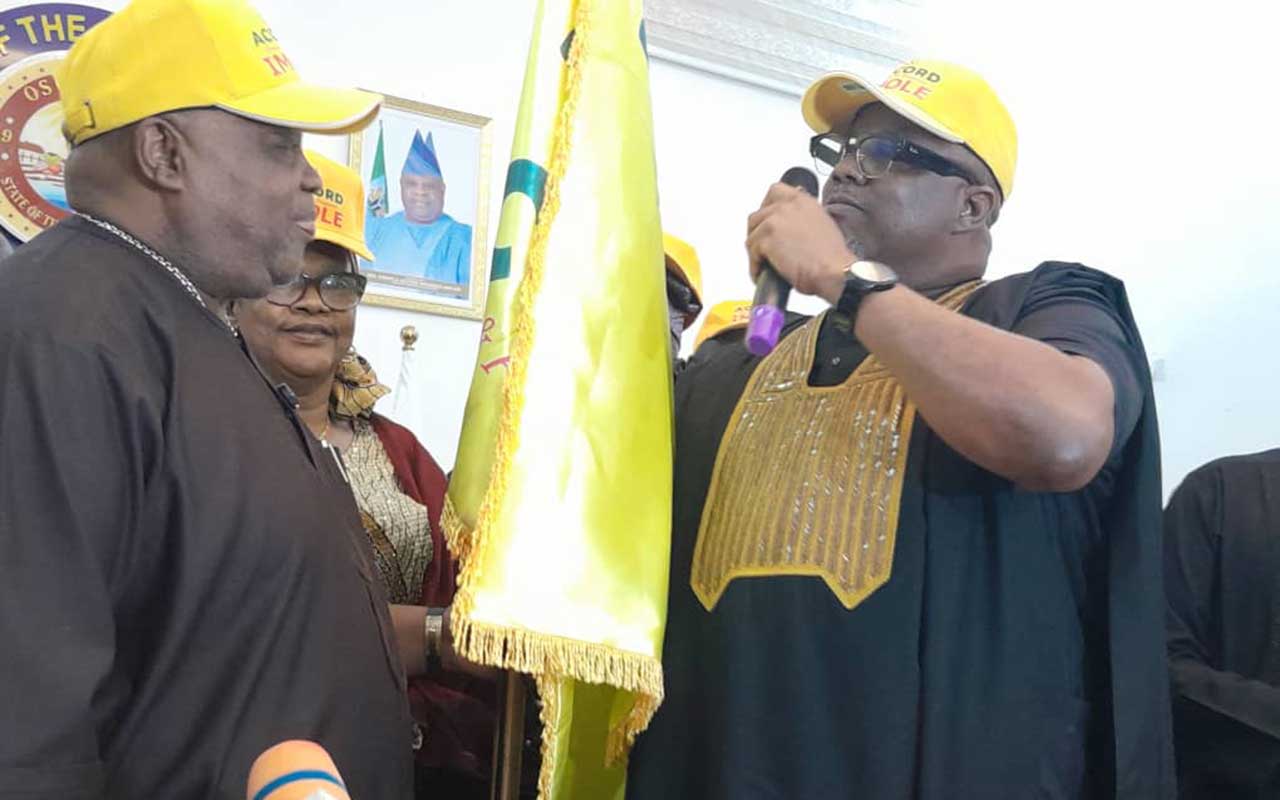
In a separate development, the embattled governor of Osun State, Ademola Adeleke, yesterday evening unveiled the Accord Party as his new political platform and announced his intention to seek re-election for a second term on the party’s platform.
The governor made the announcement at the Banquet Hall of the Government House in the presence of national and state leaders of the Accord Party.
He said, “I joined the Accord Party more than a month ago — precisely November 6 — as a platform to seek re-election in 2026. This was after weeks of consultation and deliberations with stakeholders and opinion leaders.”
On the choice of the Accord Party, Adeleke said, “Stakeholders and residents of Osun State are aware of why we are taking this important decision. We intend to pursue a second term in office on the platform of the Accord Party to complete ongoing delivery of good governance and democratic dividends, which have been applauded at home and abroad. We opted for the Accord Party because its mission of welfarism aligns with our passionate focus on citizens’ and workers’ welfare.”
The governor added, “I welcome our party leaders into the Osun State Government House. You are now part of us, as I am also now part of you. We are united in progress and good intentions for the good people of Osun State and Nigeria at large.
“At this historical point, our task is to sustain a united front as we prepare for the elections. We have a duty to ensure inclusive leadership where the interests of all groups are cared for. Our party, Accord Party, is here to take over Osun governance and sustain the delivery of good governance in our dear state.”
He continued, “Since I joined the party more than a month ago, I have been fascinated by the philosophy of this great party. The focus on people’s welfare should always be at the heart of public leadership. The primary essence of a government is the welfare and well-being of the people.
“As a governor, I have prioritised the welfare of our people, from workers to the entire citizenry. Day and night, we implement policies and programmes to elevate the well-being of our people. From infrastructure to social services, Osun has never had it so good in governance and service delivery.
“Today, we unveil the new platform for the good people of Osun State. From Osun West to Osun East to Osun Central, this is our party, our new platform for victory come August next year. From Igbomina to Ijeshaland to Ife land to Osogbo to Iwoland to Modakeke to Gbongan to Igbajo to Ikire to Ikirun to Ede and other lands of Osun State, we must give thumbs-up according to our collective desires for good governance.
“Osun voted for good governance in 2022, and they will support continuity in 2026. The mass of our people are for continuity, and Accord is our party for victory next year. In accordance with the will of our stakeholders and to accord deep respect for the wishes of the Osun people, I hereby accordingly declare for the Accord Party,” the governor announced in a statement by his spokesperson, Olawale Rasheed.
However, PDP Publicity Secretary for the South-West zone, Sanya Atofarati, said it was not a surprise that Fubara and Adeleke decided to exit the party.
“We foresaw it, and it has come to pass. One of the pacts signed after the suspension of Fubara was that he would move to the APC, which has now happened. But beyond that, we all saw the intimidation and coercion.
“The same thing applied to Adeleke. He visited President Tinubu in Lagos during the Salah and thereafter openly endorsed Mr President for a second term. He even promised to vote for him, but the APC wants to take Osun at all costs. I can assure you that President Tinubu will fail in his attempt to turn the country into a one-party state.”
Meanwhile, singing joyfully when asked to comment on Governor Ademola Adeleke’s defection to the Accord Party, the Osun State spokesman of the All Progressives Congress (APC), Kola Olabisi, said the state is as good as won by his party in 2026.
He said the governor did not defeat the APC in the 2022 governorship election. “It was a collaborative gang-up that gave him victory. Now that he has moved to Accord, let him test his popularity at the polls,” he said.
According to Olabisi, “It does not matter when Governor Adeleke contests; he will lose the seat next year. The people of Osun will vote him out because they have seen enough of dancing. What happened in Ede during the last election cannot be repeated next year.”
Turaki-led PDP describes Fubara’s defection as “self-inflicted injury”
The Kabiru Turaki-led Peoples Democratic Party has reacted to the defection of Rivers State Governor, Siminalayi Fubara, to the ruling All Progressives Congress, describing the move as a “self-inflicted injury” and a culmination of choices the governor “willingly embraced.”
In a statement issued yesterday by its National Publicity Secretary, Ini Ememobong, the party said Fubara’s exit merely affirmed the legal maxim ‘volenti non fit injuria’ — “to one who is willing, no harm is done.”
According to the PDP, the governor’s political troubles and eventual departure were products of his own decisions.
“Everyone who has followed developments that culminated in this uneventful defection will recall that the governor willingly travelled the path that took him to this destination,” the statement read.
“Having done so voluntarily, he cannot turn around and accuse our party or any person or group of failing to protect him.”
The party insisted that at every stage of the crisis that engulfed Rivers politics over the past year, civil society groups, democratic actors and Nigerians across political divides stood in Fubara’s defence until he “capitulated.” It added that rather than blame others, the governor should acknowledge the support he enjoyed before choosing his new path.
Expressing concern about what it described as Fubara’s political capitulation, the PDP warned against the “Stockholm Syndrome” — a condition in which a victim develops affection for their oppressor — suggesting that the governor may have succumbed to pressures from forces aligned with the Federal Government.
“In all, despite these, we pity the governor and wish him well,” the party added.
The PDP further used the development to highlight what it called the “dysfunctional nature of Nigeria’s democracy,” lamenting a political environment where individuals wield power beyond institutions and allegedly deploy federal might to overwhelm opponents.
It warned that such tendencies threaten democratic stability and should be condemned by all well-meaning Nigerians.
With Fubara’s defection, the opposition party renewed its accusation that the ruling APC is bent on creating a one-party state and shrinking Nigeria’s political space. “Democracy is under severe attack,” the statement noted, urging Nigerians and the international community to resist what it called a slide toward electoral authoritarianism.
